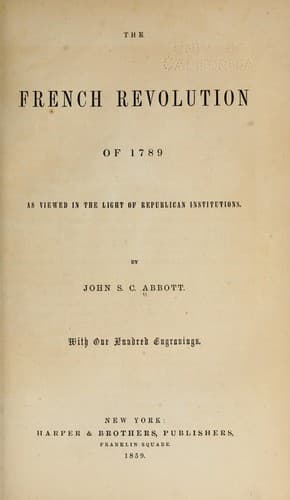
The French Revolution of 1789, as Viewed in the Light of Republican InstitutionsAbbott, John S. C. (John Stevens Cabot)
History
The French Revolution of 1789, as Viewed in the Light of Republican Institutions
Abbott, John S. C. (John Stevens Cabot)
France -- History -- Revolution, 1789-1799
The queen attended the sitting in a private box. The disrespect
with which the king was treated pierced her very soul. She sat as
in a stupor of silence, her countenance, pallid and wan, betraying
the bitterness of her anguish. The king, upon leaving the Assembly,
hastened immediately to the private apartment of the queen. He was so
pale and agitated that the queen uttered an exclamation of surprise.
The unhappy monarch threw himself upon a sofa, and, pressing a
handkerchief to his eyes, said,
"All is lost! Ah! madam, and you are witness to this humiliation. What!
you are come to France to see--"
"These words," writes Madame Campan, "were interrupted by sobs. The
queen threw herself upon her knees before him, and pressed him in her
arms. I remained with them, not from any blamable curiosity, but from
a stupefaction which rendered me incapable of determining what I ought
to do. The queen said to me, '_Oh go, go_,' with an accent which
expressed, 'Do not remain to witness the dejection and despair of your
sovereign.' I withdrew, struck with the contrast between the shouts
of joy without the palace, and the profound grief which oppressed the
sovereigns within."
The queen resolved immediately to leave Paris and to return to her
friends in Vienna, that from the heart of Austria she might plan for
the recovery of the throne. The king so far fell in with this plan
as to write a letter which M. Goguelat was to take to the emperor.
During the whole day the garden and court-yard of the Tuileries were
thronged, and the rejoicing shouts of the people filled the air. The
ignorant populace, believing that the king and the queen shared their
joy, called loudly for them to take an airing in their carriage in the
Elysian Fields. It was not deemed prudent to decline. With heavy hearts
they entered their carriage, and rode slowly along the magnificent
avenue, escorted by the officers of the Parisian army. Here a new
insult awaited them. Though they were repeatedly greeted with shouts
of "_Vive le Roi!_" a gigantic man, with stentorian voice, kept near
the carriage window, ever interrupting those shouts with the cry, "_No,
don't believe them_. _Vive la Nation!_" This one ill-omened voice,
incessantly reiterated, sank deep into their hearts, and obliterated
all impressions of public acclaim. In the deepest dejection they
returned to the palace.[305]
That night Paris blazed with illuminations, and the shouts of joyful
revelry filled all the streets; but in these resounding plaudits the
queen heard but the death-knell of the monarchy, and, in the retirement
of her boudoir, she was at midnight planning her escape from France.
Public-domain text, read in full here on John Shaqi.
Reviews
Reviews
No reviews yet
Be the first to share your thoughts on this work.
Elsewhere in the archive
Join the Discussion
Join the discussion
Sign in to leave a comment or review.
Sign InorCreate an account