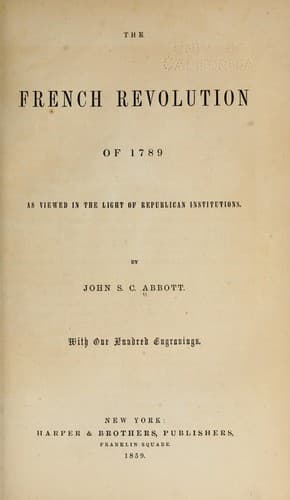
The French Revolution of 1789, as Viewed in the Light of Republican InstitutionsAbbott, John S. C. (John Stevens Cabot)
History
The French Revolution of 1789, as Viewed in the Light of Republican Institutions
Abbott, John S. C. (John Stevens Cabot)
France -- History -- Revolution, 1789-1799
The queen was unrelenting in her hostility to La Fayette, and often
treated him with the most irritating rudeness. "Her aversion," says
Madame Campan, "for the general increased daily, and grew so powerful
that when, toward the end of the Revolution, he seemed willing to
support the tottering throne she could never bring herself to incur
so great an obligation to him."[310] On one occasion La Fayette met
the queen in a private interview, while his aids waited for him in the
saloon. Some of the ladies of the court, to insult La Fayette and his
aids, said loudly, "_It is very alarming to see the queen alone with a
rebel and a brigand_."
The feelings of the king were now so outraged that he could not
cheerfully persevere in his resolves to maintain the new order of
affairs. The allied sovereigns were, however, so embarrassed by the
acceptance of the Constitution by the king, and by the reiterated
declaration of the king that he accepted and adopted the whole system
of governmental reform, that they hesitated for a time to carry into
execution the declaration of Pilnitz. Louis XVI. notified all the
courts of Europe of the change which had been introduced into the
government of France, and sent to them all, with much ceremonial pomp,
a copy of the Constitution elegantly engrossed upon satin paper. The
allies could no longer pretend that they were waging war against a
_revolted people_. It was now necessary, if they continued hostile, to
assail the legitimate king, and to deny, in the face of the world, that
the government of France had any right to mitigate the severity of its
despotism.
The courts of Europe were quite bewildered by the new aspect which
affairs thus assumed. It was necessary for them to take some notice
of the courteous communication which had been transmitted to them.
Leopold of Austria seemed disposed to give up the conflict, thinking
that the safety of his sister Marie Antoinette would be promoted by
peace. He therefore returned a pacific answer. Prussia and England sent
back courteous replies with assurances of their amicable intentions.
Holland, the Italian principalities, and Switzerland assumed a friendly
attitude. Russia was cold, haughty, and reserved. Gustavus of Sweden
returned the insulting reply that the King of France was a prisoner,
and that his assent to the Constitution was obtained upon compulsion,
and therefore deserved no respect from the foreign powers.[311] The
Electors of Treves and of Mentz, in whose territories the emigrants
had mostly taken refuge, returned evasive and unsatisfactory replies.
Spain, also, while declaring that she had no wish to disturb the
internal tranquillity of France, could not conceal her displeasure that
free institutions were established so near her borders.
Public-domain text, read in full here on John Shaqi.
Reviews
Reviews
No reviews yet
Be the first to share your thoughts on this work.
Elsewhere in the archive
Join the Discussion
Join the discussion
Sign in to leave a comment or review.
Sign InorCreate an account