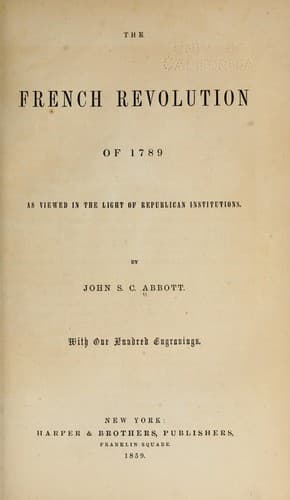
The French Revolution of 1789, as Viewed in the Light of Republican InstitutionsAbbott, John S. C. (John Stevens Cabot)
History
The French Revolution of 1789, as Viewed in the Light of Republican Institutions
Abbott, John S. C. (John Stevens Cabot)
France -- History -- Revolution, 1789-1799
The emigrants, however, were still rallying at Coblentz and making
formidable preparations for war. The king was vacillating. It is
certain that he sent, apparently, the most sincere injunctions to the
emigrants at Coblentz to disband and to return to France, accepting the
new order of things. It is equally certain that he kept up a private
correspondence with the emigrants, encouraging them to persevere and to
march to his rescue.[312]
This hostile gathering at Coblentz, ever threatening the kingdom with
invasion, kept France in a continual state of ferment. The Minister of
War reported to the Assembly that nineteen hundred of the officers of
the army had deserted their posts and joined the menacing foe. After a
long and very anxious debate, a decree was passed declaring that the
French emigrants assembled at Coblentz were believed to be conspiring
against France; that if, on the 1st of January next, they still
continued assembled, they should be declared guilty of conspiracy,
prosecuted as such, and punished with death; and that the revenues of
those who refused to comply with this decree should be levied, during
their lives, for the benefit of the nation, without prejudice to the
rights of wives, children, and lawful creditors.[313]
The king, on the 10th of November, returned this law with his _veto_.
It was an imposing scene. All the ministers of the king, in a body,
went to the Assembly. It was generally understood that the power of the
_veto_ was to be exercised. Breathless silence pervaded the Assembly.
The bill was returned to the president with the official formula,
"_The king will examine it_." Loud murmurs immediately rose from all
parts of the house, and the ministers retired, leaving the Assembly in
deep irritation. The conviction was strengthened that the king was in
sympathy with the conspirators.
To efface this impression the king the next day issued a proclamation
to the emigrants exhorting them to cease to harass France by their
threatening attitude, and like good citizens to return and respect
the established laws of their country. He entreated them not to compel
him to employ severe measures against them. As to the charge that he
was deprived of his liberty, he said that the _veto_ which he had just
interposed in their favor was sufficient proof of the freedom of his
actions. At the same time he published two very decisive letters to his
two brothers. To Louis he wrote as follows:
"Paris, November 11, 1791.
Public-domain text, read in full here on John Shaqi.
Reviews
Reviews
No reviews yet
Be the first to share your thoughts on this work.
Elsewhere in the archive
Join the Discussion
Join the discussion
Sign in to leave a comment or review.
Sign InorCreate an account