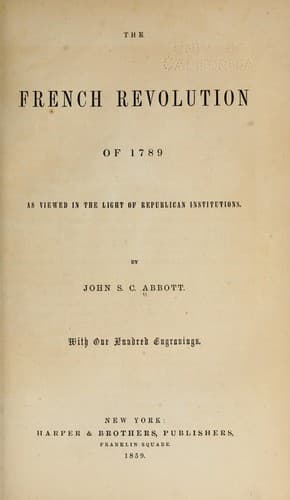
The French Revolution of 1789, as Viewed in the Light of Republican InstitutionsAbbott, John S. C. (John Stevens Cabot)
History
The French Revolution of 1789, as Viewed in the Light of Republican Institutions
Abbott, John S. C. (John Stevens Cabot)
France -- History -- Revolution, 1789-1799
Upon the completion of the Constitution, La Fayette, emulating the
character of Washington, resigned the command of the National Guard
and retired to his estates. Bailly also resigned his post as mayor of
Paris. The command of the Guard was intrusted to six generals, who were
to exercise it in rotation. A new mayor of Paris was to be chosen. La
Fayette was the candidate of the Constitutionalists, and Pétion of
that radical portion of the Republicans who were termed Jacobins. The
aristocracy, with their accustomed infatuation, supported Pétion with
their influence and with a large outlay of money. They feared that a
constitutional monarchy might be sustained, but they believed that the
Jacobins would introduce such anarchy as might secure the recall of the
old monarchy.
"The Marquis de la Fayette," said the queen, "only desires to be Mayor
of Paris that he may be _mayor of the palace_. Pétion is a Jacobin and
a Republican; but he is a fool, incapable of ever being the leader of
a party. He will be a nullity of a mayor. Besides, it is possible that
the knowledge of the interest we take in his election may bring him
over to the king."[314]
Pétion was chosen by a large majority. Bitterly did the king and queen
afterward bewail his election. But thus through all this tragedy did
they spurn those who alone had the heart and the ability to help them.
In the midst of these troubles the most alarming rumors were every day
reaching Paris respecting the threatening aspect of the emigrants. All
along the Germanic frontiers, at Strasbourg, Coblentz, Worms, they
were marshaling their battalions and collecting munitions of war.
Exasperated by these persistent and audacious threats, the Assembly
sent a deputation of twenty-four members to the king with a decree
declaring that the Electors of Treves and Mentz, and other princes
of the Germanic empire should be required to break up these hostile
assemblages formed within their territories for the invasion of France.
M. de Vaublanc, who headed the deputation, said to the king,
"Sire, if the French who were driven from their country by the
revocation of the Edict of Nantes had assembled in arms on the
frontiers, and had been protected by Germanic princes, we ask you,
sire, what would have been the conduct of Louis XIV.? Would he have
suffered these assemblages? That which he would have done for the
sake of his authority, your majesty can not hesitate to do for the
maintenance of the Constitution."
The king, anxious to regain the ground he had lost by his _veto_,
decided to go to the Assembly and reply in person to their message. On
the evening of the 14th of December, his coming having been previously
announced, he entered the hall. He was received with the most frigid
silence. His speech, however, soon enkindled enthusiasm and applause.
Public-domain text, read in full here on John Shaqi.
Reviews
Reviews
No reviews yet
Be the first to share your thoughts on this work.
Elsewhere in the archive
Join the Discussion
Join the discussion
Sign in to leave a comment or review.
Sign InorCreate an account