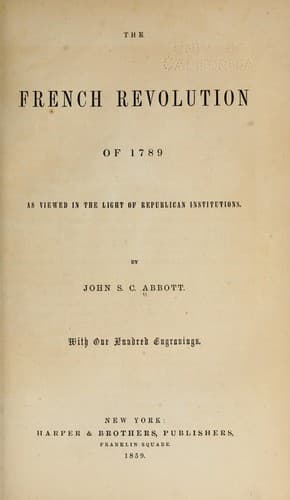
The French Revolution of 1789, as Viewed in the Light of Republican InstitutionsAbbott, John S. C. (John Stevens Cabot)
History
The French Revolution of 1789, as Viewed in the Light of Republican Institutions
Abbott, John S. C. (John Stevens Cabot)
France -- History -- Revolution, 1789-1799
In the Province of Vendée the majority of the clergy refused to take
the oath, and carried with them the immense majority of the simple and
superstitious peasants. The churches in which they had ministered were
immediately assigned to other priests who had taken the oath. The great
mass of the people abandoned the churches and followed their nonjuring
pastors to private houses, barns, and into the fields. Great enthusiasm
was excited, and the nonjuring priests endeavored to excite the people
against their colleagues who had taken the oath, and against the people
who accepted their ministrations. Acts of violence were frequent and
civil war was imminent.
The Legislative Assembly was alarmed, and endeavored to meet the
difficulty by adopting measures totally hostile to the free spirit of
the Constitution. They resolved that the nonjuring priests should again
be called upon to take the oath of allegiance to the Constitution;
that, if they refused, they should be not only deprived of all salary,
but should be removed from their parishes, and even imprisoned, if need
be, that they might not excite their former parishioners to civil war.
They were also forbidden to exercise the privilege of private worship.
The administrative bodies were required to transmit a list of such
priests to the Assembly, with notes relative to the conduct of each one.
These decrees were surely unconstitutional. The bishops and the priests
who were endangered by them sent to the king an earnest remonstrance
against them. Many of the most influential of the Constitutionalists
were opposed to them as both tyrannical and cruel. The king was so
moved that he said to his ministers, who coincided with him in opinion,
"They shall take my life before they shall compel me to sanction such
decrees."
The king returned the bill with his _veto_, and aggravated the odium
this would naturally excite by retaining, contrary to the solicitations
of his best friends, nonjuring ecclesiastics to perform the religious
services of his chapel. Though we can not commend the _prudence_ we
must respect the _spirit_ which impelled him to say,
"The Constitution decrees freedom of religious worship for every body.
The king is surely entitled to that liberty as much as his subjects."
All argument was on one side, but peril, more powerful than argument,
on the other. "The nonjuring priests," it was exclaimed, "are exciting
civil war. The law of self-defense renders it imperative that we should
strike them down."
Public-domain text, read in full here on John Shaqi.
Reviews
Reviews
No reviews yet
Be the first to share your thoughts on this work.
Elsewhere in the archive
Join the Discussion
Join the discussion
Sign in to leave a comment or review.
Sign InorCreate an account