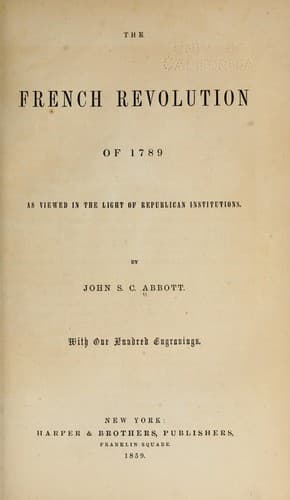
The French Revolution of 1789, as Viewed in the Light of Republican InstitutionsAbbott, John S. C. (John Stevens Cabot)
History
The French Revolution of 1789, as Viewed in the Light of Republican Institutions
Abbott, John S. C. (John Stevens Cabot)
France -- History -- Revolution, 1789-1799
[Footnote 311: The Empress Catharine of Russia wrote to Marie
Antoinette a letter with her own hand, containing the following
sentence: "Kings ought to proceed in their career, undisturbed by the
cries of the people, as the moon pursues her course unimpeded by the
howling of dogs."--_Madame Campan_, vol. i., p. 207.]
[Footnote 312: Mémoires de Madame Campan, t. ii., p. 172.]
[Footnote 313: Thiers, vol. i., p. 204.]
[Footnote 314: Bertrand's Private Memoirs, vol. v., p. 106.]
[Footnote 315: There was an earnest debate in February, 1800, in the
British House of Commons as to who were the aggressors in this war. Mr.
Pitt denounced the French as the aggressors. Mr. Fox, on the contrary,
affirmed that the war was unavoidable on the part of France from the
menacing conduct of the German powers.]
[Footnote 316: Mémoires de Bouillé, p. 314.]
CHAPTER XXV.
AGITATION IN PARIS, AND COMMENCEMENT OF HOSTILITIES.
Death of Leopold.--Assassination of Gustavus.--Interview between
Dumouriez and the Queen.--Discussion in the Assembly.--The Duke
of Brunswick.--Interview of Barnave with the Queen.--Interview
between Dumouriez and the King.--Dismissal of M. Roland.--The Palace
invaded.--Fortitude of the King.--Pétion, the Mayor.--Affecting
Interview of the Royal Family.--Remarks of Napoleon.
On the 1st of March, 1792, the Emperor Leopold died. His son, Francis
II., a young man twenty-four years of age, ascended the throne. The
court of Leopold had been a harem of unblushing sensuality and sin. He
did not condescend to spread any veil over his amours. His attachments
were numerous and fugitive, and his guilty favorites associated with
each other and braved the frowns of the humiliated queen amid the
voluptuousness of the palace. At the time of his death there dwelt with
him Donna Maria, a young girl from Tuscany, whose surpassing charms had
given her celebrity throughout Europe as "the beautiful Florentine;"
a Polish girl of great attractions, Mademoiselle Prokache; and the
Countess of Walkenstein, whose charms of person and fascination of
manners gave her celebrity through all the European courts. Upon this
latter favorite alone he lavished gifts, in drafts on the Bank of
Vienna, to the amount of two hundred thousand dollars. There were also
various other of these favorites of infamy, inferior in notoriety
and rank. The annals of Roman story may be searched in vain to find a
monarch more utterly profligate. Immediately after his death his widow
said to her son Francis,
"My son, you have before you the sad proofs of your father's disorderly
life and of my long afflictions. Remember nothing of them except my
forgiveness and his virtues. Imitate his great qualities, but beware
lest you fall into the same vices, in order that you may not, in your
turn, put to the blush those who scrutinize your life."
Public-domain text, read in full here on John Shaqi.
Reviews
Reviews
No reviews yet
Be the first to share your thoughts on this work.
Elsewhere in the archive
Join the Discussion
Join the discussion
Sign in to leave a comment or review.
Sign InorCreate an account