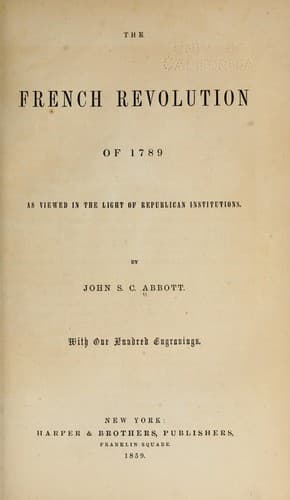
The French Revolution of 1789, as Viewed in the Light of Republican InstitutionsAbbott, John S. C. (John Stevens Cabot)
History
The French Revolution of 1789, as Viewed in the Light of Republican Institutions
Abbott, John S. C. (John Stevens Cabot)
France -- History -- Revolution, 1789-1799
Marie Antoinette doubted not that her cousin Francis would be as
devoted to her interests as her brother Leopold had been. Fifteen days
after the death of Leopold, Gustavus III. of Sweden was assassinated
at a masked ball by the nobles of his court. His death momentarily
embarrassed the movements of the emigrants, for he was actively engaged
in raising an army for the invasion of France.[317]
The allies were now vigorously raising troops and directing their march
towards the frontiers of France. Some hoped that the demonstration
would overawe the French and frighten them into submission. Others were
eager, by prompt invasion, to submit the question to the arbitrament
of battle. The Assembly speedily dispatched to the threatened frontier
three armies of defense. Rochambeau was placed in command of the army
of the north, at Flanders, consisting of 63,000 men; La Fayette was
sent to the army of the centre, at Metz, which was 52,000 strong;
Luckner occupied Alsace, with 48,000 troops.[318]
In calling the Girondists into the ministry, General Dumouriez, a brave
and veteran soldier, was appointed to the ministry of foreign affairs.
With great vigor he prosecuted arrangements for the defense of France.
In addition to the troops, amounting to 163,000, stationed along the
northwestern frontier from Dunkirk to Besançon, he raised a fourth army
to repel invasion from Spain through the passes of the Pyrenees.
Dumouriez had acquired great popularity in the club of the Jacobins
by frequenting their meetings, and by wearing the red cap of liberty,
an emblem borrowed from the Phrygians. The queen was highly indignant
that one in sympathy with the Jacobins should be called into the
ministry, and, as she was now heartily in sympathy with the emigrants
and the allies, she was provoked by the vigorous measures adopted to
repel them. Dumouriez was a soldier, not a statesman; a man of heroic
character, brave, impulsive, and generous. He had great power over
the mind of the king; and the queen, anxious to see him, appointed
an audience. In the memoirs of Dumouriez we find a narrative of this
interview. Upon being ushered into her apartment, he found the queen,
with flushed cheeks, rapidly pacing the floor, and giving every
indication of extreme excitement. Dumouriez, embarrassed by this aspect
of affairs, advanced in silence to a corner of the fire-place, when
the queen turned toward him and abruptly said, with an air and tone of
anger,
"Sir, you are all-powerful at this moment, but it is through the favor
of the people, who soon break their idols in pieces. Your existence
depends upon your conduct. It is said that you possess great abilities.
You must be aware that neither the king nor myself can endure these
innovations, nor the Constitution. This I tell you frankly. Choose your
side."
Public-domain text, read in full here on John Shaqi.
Reviews
Reviews
No reviews yet
Be the first to share your thoughts on this work.
Elsewhere in the archive
Join the Discussion
Join the discussion
Sign in to leave a comment or review.
Sign InorCreate an account