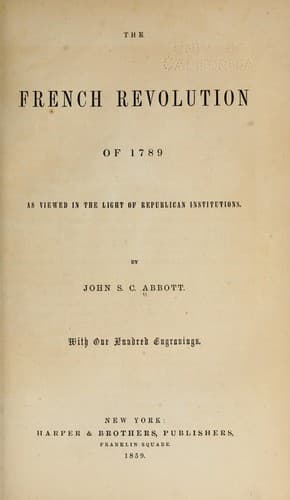
The French Revolution of 1789, as Viewed in the Light of Republican InstitutionsAbbott, John S. C. (John Stevens Cabot)
History
The French Revolution of 1789, as Viewed in the Light of Republican Institutions
Abbott, John S. C. (John Stevens Cabot)
France -- History -- Revolution, 1789-1799
On the 20th of June there was an immense gathering of the populace
of Paris, and of delegates from other parts of the kingdom, to
celebrate the anniversary of the meeting in the tennis-court, and to
present a petition to the king urging him to withdraw his vetos. Deep
apprehensions were felt in several quarters respecting the results of
the day. Pétion, who was then mayor of the city, did not venture to
prohibit the celebration, but adopted the precaution of doubling the
guard of the Tuileries.
[Illustration: FESTIVAL IN HONOR OF LIBERTY.]
Early in the morning the whole city was in commotion, and vast crowds
were hurrying to the various points of concentration. The Assembly met
at eleven o'clock, and was alarmed in view of the possible issues of
the day, and agitated by discordant councils. The session soon became
tumultuous, the Constitutionalists wishing to repress the disorder
which the Jacobins were ready to foment. In this state of affairs a
letter was brought into the Assembly from Santerre, a brewer, who had
become notorious as a leader of the populace.[327] It stated that the
citizens were merely celebrating the anniversary of the 20th of June;
that they were calumniated in the Assembly; and that they beg to be
admitted to the bar of the Assembly that they might confound their
slanderers.
The reading of this letter vastly increased the tumult. In the midst
of cries of order, and a scene of indescribable confusion, it was
announced that the petitioners, with arms and banners, in a prolonged
procession of thirty thousand men, were approaching the hall. All power
of law seemed paralyzed, and bewilderment and consternation reigned.
Soon the head of the procession, like a lava-flood, crowded in at the
door, and, pressed by the resistless mass behind, was forced slowly
through the hall, and made its egress at an opposite portal. They bore
enormous tables, upon which were placed the Declaration of Rights.
Around these tables danced women and boys waving olive-branches and
brandishing pikes, thus emblematically declaring themselves ready for
peace or war.
The enormous procession filed slowly through the hall, shouting in
deafening chorus the famous "_Ça ira_" (bravely it goes), armed
with every conceivable weapon, and waving banners inscribed with
revolutionary devices. Several bore ragged breeches upon poles, while
the crowd around shouted, "_Vivent les sans culottes!_" One man bore on
the point of a pike a calf's heart, with the inscription beneath, "_The
heart of an aristocrat_."[328]
Public-domain text, read in full here on John Shaqi.
Reviews
Reviews
No reviews yet
Be the first to share your thoughts on this work.
Elsewhere in the archive
Join the Discussion
Join the discussion
Sign in to leave a comment or review.
Sign InorCreate an account