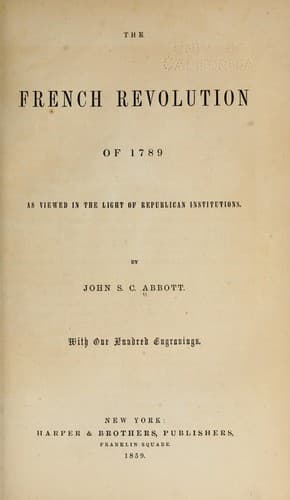
The French Revolution of 1789, as Viewed in the Light of Republican InstitutionsAbbott, John S. C. (John Stevens Cabot)
History
The French Revolution of 1789, as Viewed in the Light of Republican Institutions
Abbott, John S. C. (John Stevens Cabot)
France -- History -- Revolution, 1789-1799
For three hours this extraordinary scene continued. The Assembly,
agitated with grief and indignation, had no resource but submission.
The mob, having passed through the hall of the Assembly, now attempted
to enter the garden of the Tuileries, but the gates were closed and
defended by numerous detachments of the National Guard. The king,
however, perhaps hoping, by a show of confidence, to disarm the
mob, ordered the garden gates to be thrown open. The mob, like an
inundation, rushed in, and with their mighty mass soon filled the whole
inclosure. Some cried out for the king to show himself. Others shouted,
"Down with the _veto_!" A few voices kindly gave utterance to the old
excuse, "The king means well, but he is imposed upon."
The mob, which now appeared countless and almost limitless, flowing
out from the garden by the gate leading to the Pont Royal, proceeded
along the quay and through the wickets of the Louvre into the Place du
Carrousel. They were soon gathered in a dense mass before the royal
gate of the palace. A strong guard there refused them admittance.
Santerre brought up two pieces of cannon to blow down the gate. Two
municipal officers then strangely ordered the gates to be thrown open.
The multitude rushed impetuously into the court, filling it in an
instant, and crowding into the vestibule of the palace. It was now four
o'clock in the afternoon. They clambered the magnificent staircase,
even dragging a piece of cannon up to the first floor, and poured in
locust legions into every part of the palace. Wherever they found a
door barred against them they speedily, with swords and hatchets, hewed
it down.
The king was in one of the interior apartments, surrounded by some of
the servants of his household and by several officers of the National
Guard. His sister, Madame Elizabeth, happened to be with him; but the
queen, who was in another room with her children, had not been able to
join her husband, so sudden had been the irruption. The crowd arrested
her in her flight in the council-chamber. She begged earnestly to be
led to her husband, but the throng pouring by was so dense that it
was impossible. Her friends placed her in a corner, and rolled the
council-table before her as a barrier.
There she stood stupefied with horror, and her eyes suffused with
tears, while the low and brutal masses, with no apparent exasperation,
end, or aim, crowded by. Her daughter clung to her side, terrified and
weeping. Her son, but seven years of age, too young to understand the
terrible significance of such an inundation, gazed upon the spectacle
with half alarmed, half pleased wonder. Some of the palace-guard
gathered around the group for its protection. Occasional scowls and
mutterings of defiance and insult alarmed the queen in behalf of her
children rather than herself. Some one handed her son the red cap of
the Jacobins. The queen, hoping that it might appease the mob, placed
it upon his head.
Public-domain text, read in full here on John Shaqi.
Reviews
Reviews
No reviews yet
Be the first to share your thoughts on this work.
Elsewhere in the archive
Join the Discussion
Join the discussion
Sign in to leave a comment or review.
Sign InorCreate an account