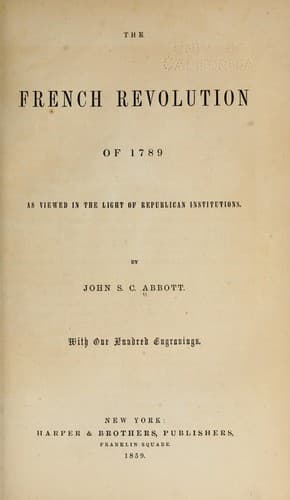
The French Revolution of 1789, as Viewed in the Light of Republican InstitutionsAbbott, John S. C. (John Stevens Cabot)
History
The French Revolution of 1789, as Viewed in the Light of Republican Institutions
Abbott, John S. C. (John Stevens Cabot)
France -- History -- Revolution, 1789-1799
Just then Santerre came along, forcing his way with the crowd. He spoke
kindly to the queen, repeating the only excuse which could be made for
her, "Madame, you are imposed upon." Seeing the red cap upon the head
of the dauphin, he, with a sense of delicacy hardly to be expected in
so coarse a man, took it and threw it aside, saying, "The child is
stifling." He then urged the people to treat the queen with respect.
A young girl stopped before the queen and assailed her with an
incessant volley of imprecations.
"Have I ever," said the queen, calmly, "done you any wrong?"
"No," replied the girl, "not me personally; but you are the cause of
the misery of the nation."
"You have been told so," answered the queen; "but you are deceived.
As the wife of the King of France and mother of the dauphin, I am a
Frenchwoman. I shall never see my own country again. I can be happy
only in France. I was happy when you loved me."
These words touched the heart of the passionate but not hardened girl,
and she began to weep, saying,
"I ask your pardon. It was because I did not know you. I see that you
are good."
While these scenes were transpiring in the council-chamber, the cries
of the mob were heard at the door of the king's apartment, and blows
from a hatchet fell heavily upon the panels. As a panel, driven by a
violent blow, fell at the king's feet, he ordered the door to be thrown
open. A forest of pikes and bayonets appeared, and the crowd rushed in.
The king, with that courage of resignation which never forsook him,
stepped forward with dignity to meet the rabble, and said, "Here I am."
His friends immediately threw themselves around him, forming a rampart
with their bodies. The mob, who seemed to have no definite object
in view, fell back, and the friends of the king placed him in the
embrasure of a window, where he could more easily be protected from the
pressure. There was a moment's lull, and then came renewed clamor and
uproar. Some said that they had a petition which they wished to present
to the king. Others shouted, "No veto! No priests! No aristocrats! The
camp near Paris."
The king stood upon a bench, and with marvelous serenity gazed upon the
unparalleled spectacle. Légendre, the butcher, one of the leaders of
the mob, stepped up, and with a firm voice demanded in the name of the
people the sanction of the two decrees which the king had vetoed.[329]
"This is not the place, neither is this the time," answered the king,
firmly, "to grant such a request. I will do all the Constitution
requires."
This bold answer seemed to exasperate the crowd, and they shouted, as
it were defiantly, "_Vive la Nation!_"
"Yes," replied the king, heroically, "_Vive la Nation!_ and I am its
best friend."
"Prove it, then," cried one of the rabble, thrusting toward him, on the
end of a pike, the red cap of the Jacobins.
Public-domain text, read in full here on John Shaqi.
Reviews
Reviews
No reviews yet
Be the first to share your thoughts on this work.
Elsewhere in the archive
Join the Discussion
Join the discussion
Sign in to leave a comment or review.
Sign InorCreate an account