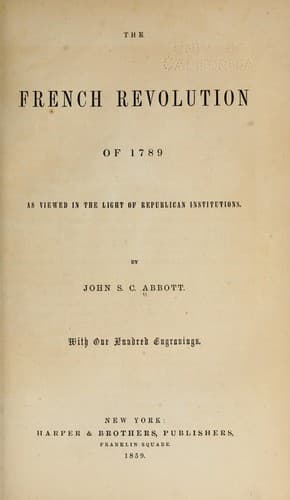
The French Revolution of 1789, as Viewed in the Light of Republican InstitutionsAbbott, John S. C. (John Stevens Cabot)
History
The French Revolution of 1789, as Viewed in the Light of Republican Institutions
Abbott, John S. C. (John Stevens Cabot)
France -- History -- Revolution, 1789-1799
The crowd obeyed and slowly moved off through the long suite of
apartments of the chateau. As soon as they began to retire the king
and his sister threw themselves into each other's arms, and neither
was able to repress a flood of tears. Locked in an embrace they left
the room to find the queen. She, with her children, had just regained
her apartment. The meeting of the royal family, after these scenes
of violence, insult, and terror, drew tears into the eyes of all
the beholders. One of the deputies, Antoine Merlin of Thionville,
though one of the most virulent of the Jacobins, could not refrain
from weeping. Marie Antoinette observing it, and knowing his bitter
hostility to the court, said,
"You weep to see the king and his family treated so cruelly by a people
whom he has always wished to render happy."
"It is true, madam," replied Merlin, "I weep over the misfortunes of
a beautiful, tender-hearted woman and mother of a family. But do not
mistake; there is not one of my tears for the _king_ or the _queen_; I
hate kings and queens."
At this moment the king, from the reflection of a mirror, saw the _red
bonnet_ still upon his head. A crimson glow flushed his face and he
hastily threw the badge of the Jacobin from him. Sinking into a chair
he for a moment buried his face in his handkerchief, and then, turning
a saddened look to the queen, said,
"Ah, madame, why did I take you from your country to associate you with
the ignominy of such a day!"
It was eight o'clock in the evening before the apartments and corridors
of the palace ceased to echo with the voices and the footsteps of
the barbarian invaders. Detachments of the National Guard gradually
assembled, the court-yard and the garden were cleared, and night
with its silence and darkness again settled down over the wretched
royal family in the halls of their palace, and the wretched famishing
outcasts wandering through the streets. Such was the 20th of June, 1792.
Napoleon Bonaparte, then twenty-two years of age, was in Paris, and
with indignation witnessed this spectacle of lawlessness. Bourrienne
thus describes the event: "In the month of April, 1792, I returned to
Paris, where I again met Bonaparte, and renewed the friendship of our
youthful days. I had not been fortunate, and adversity pressed heavily
upon him. We passed our time as two young men of three and twenty may
be supposed to have done who had little money and less occupation. At
this time he was soliciting employment from the Minister of War, and I
at the office of foreign affairs.
Public-domain text, read in full here on John Shaqi.
Reviews
Reviews
No reviews yet
Be the first to share your thoughts on this work.
Elsewhere in the archive
Join the Discussion
Join the discussion
Sign in to leave a comment or review.
Sign InorCreate an account