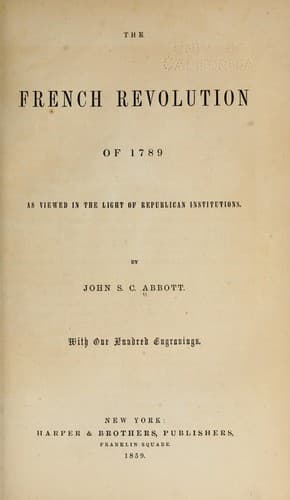
The French Revolution of 1789, as Viewed in the Light of Republican InstitutionsAbbott, John S. C. (John Stevens Cabot)
History
The French Revolution of 1789, as Viewed in the Light of Republican Institutions
Abbott, John S. C. (John Stevens Cabot)
France -- History -- Revolution, 1789-1799
"While we were thus spending our time the 20th of June arrived,
a sad prelude of the 10th of August. We met by appointment at a
restaurateur's, in the Rue St. Honoré, near the Palais Royal. On going
out we saw a mob approaching in the direction of the market-place,
which Bonaparte estimated at from five to six thousand men. They were
a parcel of blackguards, armed with weapons of every description, and
shouting the grossest abuse, while they proceeded at a rapid rate
toward the Tuileries. This mob appeared to consist of the vilest and
most profligate of the population of the suburbs.
[Illustration: THE ATTACK UPON THE TUILERIES.]
"'Let us follow the rabble,' said Bonaparte. We got the start of them,
and took up our station on the terrace bordering on the river. It was
there that he was an eye-witness of the scandalous scenes which ensued,
and it would be difficult to describe the surprise and indignation
which they excited in him. Such weakness and forbearance, he said,
could not be excused. But when the king showed himself at the window
which looked out upon the garden, with the red cap which one of the
mob had just placed upon his head, he could no longer repress his
indignation.
"'What madness!' he loudly exclaimed. 'How could they have allowed that
rabble to enter? Why did they not sweep away four or five hundred of
them with the cannon? The rest would then have speedily taken to their
heels.'"
FOOTNOTES:
[Footnote 317: At the moment of Leopold's death all was ready for
hostilities. Two hundred thousand men were under arms for the invasion.
The Duke of Brunswick, who was placed in command, was at Berlin
receiving the final commands of the king. Another Prussian general was
at Vienna receiving from Leopold advice as to the time and point of
attack. Leopold, whose constitution was shattered by debauchery, was
taken suddenly sick, and, after two days of excruciating pain, died
in convulsions. His death was probably caused by an immoderate use of
drugs to recruit his system, enervated by dissipation. This event for a
short time paralyzed the energies of the coalition. See History of the
Girondists, by Lamartine, vol. i., p. 364.]
[Footnote 318: Memoirs of Count Mathieu Dumas, vol. i., p. 190.]
Public-domain text, read in full here on John Shaqi.
Reviews
Reviews
No reviews yet
Be the first to share your thoughts on this work.
Elsewhere in the archive
Join the Discussion
Join the discussion
Sign in to leave a comment or review.
Sign InorCreate an account