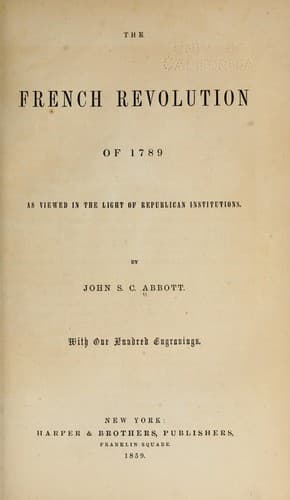
The French Revolution of 1789, as Viewed in the Light of Republican InstitutionsAbbott, John S. C. (John Stevens Cabot)
History
The French Revolution of 1789, as Viewed in the Light of Republican Institutions
Abbott, John S. C. (John Stevens Cabot)
France -- History -- Revolution, 1789-1799
Pétion, thus summarily turned out of doors, bowed and left. The report
of the angry interview was speedily spread through Paris. It was
rumored _through the palace_ that the mob were preparing to rise to
murder the king and all the royal family. It was rumored _through the
streets_ that the Royalists were endeavoring to provoke the people to
rise, that they might shoot them down with artillery. The mayor issued
a proclamation urging the people not to allow themselves to be excited
to fresh commotions. The king issued a proclamation, spirited and
defiant in its tone, and yet calculated only to exasperate those whom
he had no power to restrain.[330]
La Fayette, who was at this time with his division of the army on the
frontiers, heard these tidings from Paris with intense alarm. Had the
court not prevented his election as mayor, the outrages of the 20th
of June could not have occurred. His only hope for France was in the
Constitution. The invasion of the Legislative Assembly by the mob, the
irruption into the palace, and the outrages inflicted upon the royal
family, impressed him with shame and horror. He saw the terrific reign
of anarchy approaching, and was fully conscious that no one could
attempt to resist the popular torrent but at the peril of his life.
He wrote a very earnest letter of remonstrance to the Assembly, and
resolved to hasten immediately to Paris, and to brave every possible
danger in endeavoring to restore to his country the dominion of law.
Making all the arrangements in his power, that his temporary absence
might not be detrimental to the military operations then in progress,
he set out for the capital, and arrived there on the 28th of June.[331]
He thought that he might rely upon the National Guard to aid him in
maintaining the Constitution, and that, throwing himself into the
breach to save the monarchy and the king, he might place some reliance
upon the co-operation of the court. But the court hated La Fayette
and constitutional liberty, and wished for no assistance but from the
armies of the allies, through whom they might dictate terms to the
re-enslaved people.
La Fayette, immediately upon his arrival in Paris, sent a message
to the Assembly that he wished for permission to address them.
At half-past one of the 28th of June, he entered the hall. The
Constitutionalists received him with plaudits. The Republicans, both
the Girondists and the Jacobins, were silent. The general, in his bold
and spirited address, spoke of the disgrace which the outrages of the
20th of June had brought upon the nation, and the indignation which it
had excited in the army, and urged that the instigators of the riot
should be prosecuted; that the Jacobin Club, ever urging violence and
revolution, should be suppressed; and that the Constitution and the
laws should be maintained by all the armed force of the government.
Public-domain text, read in full here on John Shaqi.
Reviews
Reviews
No reviews yet
Be the first to share your thoughts on this work.
Elsewhere in the archive
Join the Discussion
Join the discussion
Sign in to leave a comment or review.
Sign InorCreate an account