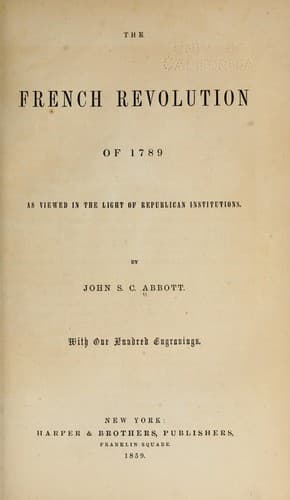
The French Revolution of 1789, as Viewed in the Light of Republican InstitutionsAbbott, John S. C. (John Stevens Cabot)
History
The French Revolution of 1789, as Viewed in the Light of Republican Institutions
Abbott, John S. C. (John Stevens Cabot)
France -- History -- Revolution, 1789-1799
This speech introduced an angry debate, in which La Fayette was
reproached with neglecting his own duties in the army to meddle with
matters in which he had no concern. La Fayette left the Assembly in the
midst of the debate, and repaired to the palace to see what assistance
he could render to the king and queen. The courtiers surrounding the
monarch, with their wonted infatuation, assailed La Fayette with the
most abusive epithets. The king and queen received him with great
coldness, and refused to accept from him of any sympathy or aid.
"If the court and the people attached to the king," writes the Marquis
de Ferrières, a decided Royalist, "had but resolved to support La
Fayette, there was force to have annihilated the two factions. But the
queen recoiled from any idea of owing her safety to a man whom she
had resolved to ruin. They refused to enter into his views, and they
thus rejected the only means of safety that Providence offered them.
Inexplicable blindness, if an explanation were not afforded by the
approaching entry of the foreign troops and the confidence reposed in
them."
The historian Toulongeon, describing these events, says, "Retired to
his hotel, La Fayette set himself to consider what was the force of
which he could avail himself. A review of the first division of the
National Guard was fixed for the next morning at break of day. The king
was to pass along the line, and La Fayette was then to harangue the
troops. But the mayor, Pétion, _was advertised of their movements by
the queen_, who feared the success of La Fayette even more than that of
the Jacobins, and a counter-order was given, and the review did _not_
take place."
La Fayette returned to the army thwarted and disheartened. His
retirement in despair from Paris was the last expiring sigh of the
Constitutional party. From this moment the Jacobins resolved upon his
destruction, and that very evening his effigy was burned at the Palais
Royal. Bertrand de Moleville, one of the most false and envenomed of
the Royalist writers, condemns La Fayette for thus leaving Paris. But
even Professor Smyth, whose English sympathies are strongly with the
court, exclaims,
Public-domain text, read in full here on John Shaqi.
Reviews
Reviews
No reviews yet
Be the first to share your thoughts on this work.
Elsewhere in the archive
Join the Discussion
Join the discussion
Sign in to leave a comment or review.
Sign InorCreate an account