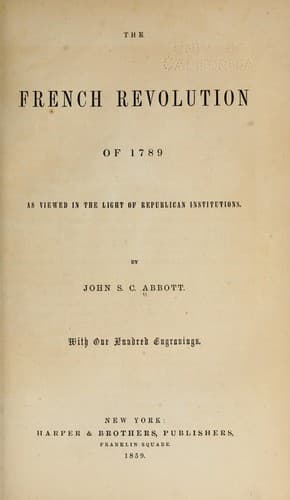
The French Revolution of 1789, as Viewed in the Light of Republican InstitutionsAbbott, John S. C. (John Stevens Cabot)
History
The French Revolution of 1789, as Viewed in the Light of Republican Institutions
Abbott, John S. C. (John Stevens Cabot)
France -- History -- Revolution, 1789-1799
"One morning, at about four o'clock, near the close of July," writes
Madame Campan, "a person came to give me information that the Faubourg
St. Antoine was preparing to march against the palace. We knew that at
least an hour must elapse before the populace, assembled upon the site
of the Bastille, could reach the Tuileries. It seemed to me sufficient
for the queen's safety that all about her should be awakened. I went
softly into her room. She was asleep. I did not awaken her.
"The king had been awakened, and so had Madame Elizabeth, who had gone
to him. The queen, yielding to the weight of her griefs, slept till
nine o'clock on that day, which was very unusual with her. The king had
already been to know whether she was awake. I told him what I had done,
and the care I had taken not to disturb her rest. He thanked me, and
said,
"'I was awake, and so was the whole palace. She ran no risk. I am very
glad to see her take a little rest. Alas! her griefs double mine.'
"What was my chagrin, when the queen, awaking and learning what had
passed, began to weep bitterly from regret at not having been called.
In vain did I reiterate that it was only a false alarm, and that she
required to have her strength recruited.
"'My strength is not exhausted,' said she; 'misfortune gives us
additional strength. Elizabeth was with the king, and I was asleep!
I, who am determined to perish by his side. I am his wife. I will not
suffer him to incur the smallest risk without my sharing it.'"
The queen appears to have understood very perfectly the character of
her dejected, spiritless, long-suffering husband. "The king," said
she, "is not a coward. He possesses abundance of passive courage, but
he is overwhelmed by an awkward shyness, a mistrust of himself, which
proceeds from his education as much as from his disposition. He is
afraid to command, and, above all things, dreads speaking to assembled
numbers. He lived like a child, and always ill at ease, under the eyes
of Louis XV., until the age of twenty-one. This constraint confirmed
his timidity. Circumstanced as we are, a few well-delivered words
addressed to the Parisians would multiply the strength of our party
a hundred-fold. He will not utter them. What can be expected from
those addresses to the people which he has been advised to post up?
Nothing but fresh outrages. As for myself, I could do any thing, and
would appear on horseback if necessary; but, if I really were to begin
to act, that would be furnishing arms to the king's enemies. The cry
against _the Austrian_, and against the sway of a female, would become
general in France, and, moreover, by showing myself I should render
the king a mere nothing. A queen who is not regent ought, under these
circumstances, to remain passive or to die."[337]
Public-domain text, read in full here on John Shaqi.
Reviews
Reviews
No reviews yet
Be the first to share your thoughts on this work.
Elsewhere in the archive
Join the Discussion
Join the discussion
Sign in to leave a comment or review.
Sign InorCreate an account