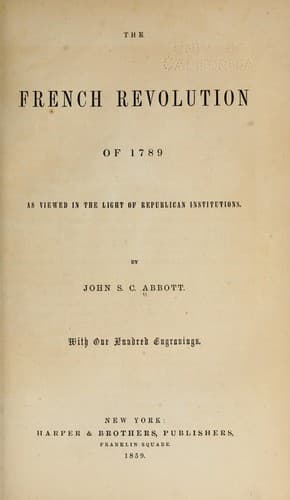
The French Revolution of 1789, as Viewed in the Light of Republican InstitutionsAbbott, John S. C. (John Stevens Cabot)
History
The French Revolution of 1789, as Viewed in the Light of Republican Institutions
Abbott, John S. C. (John Stevens Cabot)
France -- History -- Revolution, 1789-1799
There were now three prominent parties in France. First, the Royalists,
with the queen and the court, controlling the ever-vacillating king,
at their head. They were plotting, through foreign armies and civil
war, to restore the political and ecclesiastical despotism of the Old
Régime. This party would have been utterly powerless but for the aid of
foreign despots. Second came the Constitutional party, with La Fayette
at its head. The king _professed_ to belong to this party, and at
times, perhaps, with sincerity, but, overruled by others, he conducted
with a degree of feebleness and fickleness which amounted to treachery.
This party had originally embraced nearly the whole nation. Never did
a nobler set of men undertake national reform than were the leaders
of the French Revolution. They sought only the happiness of France,
were anxious for peace with all nations, were decidedly conservative
in their views. They had no desire to overthrow the French monarchy,
but wished only to limit that monarchy by a Constitution which should
secure to the nation civil and religious liberty.
But the Constitutional party was now daily growing weaker, simply
because its best friends saw that it was impossible to maintain the
Constitution while the king himself was co-operating with foreign
armies for its overthrow. Why should the people sustain a king, and
furnish him with a salary of five millions of dollars a year, only to
enable him to overthrow the Constitution and reinstate the rejected
despotism? Thus were thousands of the purest men in France driven with
great reluctance to the conviction that constitutional liberty could
only be preserved by dethroning the king and establishing a republic.
They were originally decidedly in favor of a constitutional monarchy.
They felt that the transition was altogether too great and too sudden
from utter despotism to republican freedom. The vast mass of the
peasant population in France could neither read nor write. They were
totally unacquainted with the forms of popular government. They were
as ignorant as children, and almost entirely under the tutelage of the
priests, to whom they believed that the keys of heaven and of hell had
been intrusted. The establishment of republican forms would render
France still more obnoxious to surrounding monarchies, and therefore
they had wished to maintain the monarchy, and they took the British
Constitution and not the American republic as their model, wishing,
however, to infuse more of the popular element into their Constitution
than has been admitted into the aristocratic institutions of England.
Public-domain text, read in full here on John Shaqi.
Reviews
Reviews
No reviews yet
Be the first to share your thoughts on this work.
Elsewhere in the archive
Join the Discussion
Join the discussion
Sign in to leave a comment or review.
Sign InorCreate an account