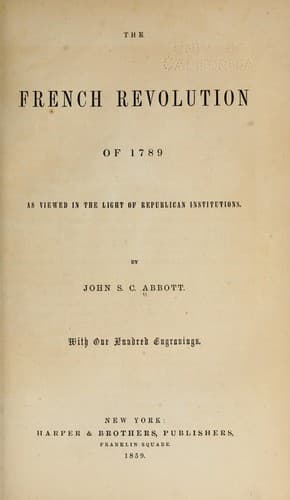
The French Revolution of 1789, as Viewed in the Light of Republican InstitutionsAbbott, John S. C. (John Stevens Cabot)
History
The French Revolution of 1789, as Viewed in the Light of Republican Institutions
Abbott, John S. C. (John Stevens Cabot)
France -- History -- Revolution, 1789-1799
"What is a formal act of opposition? If one hundred thousand Austrians
were marching toward Flanders, and one hundred thousand Prussians
toward Alsace, and the king were to oppose to them ten or twenty
thousand men, would he have done a formal act of opposition? If the
king, whose duty it is to notify us of imminent hostilities, apprised
of the movements of the Prussian army, were not to communicate any
information upon the subject to the National Assembly; if a camp of
reserve necessary for stopping the progress of the enemy into the
interior were proposed, and the king were to substitute in its stead
an uncertain plan which it would take a long time to execute; if the
king were to leave the command of an army to an intriguing general
(La Fayette) of whom the nation was suspicious. If another general
(Luckner) familiar with victory were to demand a re-enforcement, and
the king were by a refusal to say to him, _I forbid thee to conquer_,
could it be asserted that the king had performed a formal act of
opposition.
"If while France were swimming in blood the king were to say to you,
'It is true that the enemies pretend to be acting for me, for my
dignity, for my rights, but I have proved that I am not the accomplice.
I have sent armies into the field; these armies were too weak, but
the Constitution does not fix the degree of their force. I have
assembled them too late; but the Constitution does not fix the time
for collecting them. I have stopped a general who was on the point of
conquering, but the Constitution does not order victories. I have had
ministers who deceived the Assembly and disorganized the government,
but their appointment belonged to me. The Assembly has passed useful
decrees which I have not sanctioned, but I had a right to act so.
I have done all that the Constitution enjoined me. It is therefore
impossible to doubt my fidelity to it.'
"If the king were to hold this language would you not have a right to
reply, 'O king, who, like Lysander, the tyrant, have believed that
truth was not worth more than falsehood, who have feigned a love for
the laws, merely to preserve the power which enabled you to defy
them--was it defending us to oppose to the foreign soldiers forces
whose inferiority left not even uncertainty as to their defeat? Was it
defending us to thwart plans tending to fortify the interior? Was it
defending us not to check a general who violated the Constitution, but
to enchain the courage of those who were serving it? No! no! man, in
whom the generosity of the French has excited no corresponding feeling,
insensible to every thing but the love of despotism, you are henceforth
nothing to that Constitution which you have so unworthily violated,
nothing to that people which you have so basely betrayed.'"
Public-domain text, read in full here on John Shaqi.
Reviews
Reviews
No reviews yet
Be the first to share your thoughts on this work.
Elsewhere in the archive
Join the Discussion
Join the discussion
Sign in to leave a comment or review.
Sign InorCreate an account