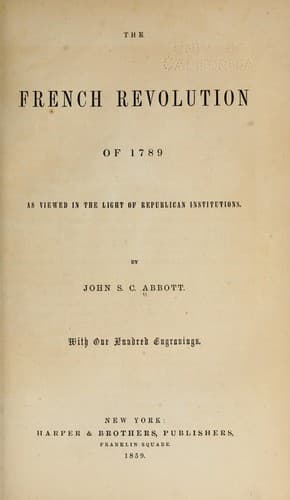
The French Revolution of 1789, as Viewed in the Light of Republican InstitutionsAbbott, John S. C. (John Stevens Cabot)
History
The French Revolution of 1789, as Viewed in the Light of Republican Institutions
Abbott, John S. C. (John Stevens Cabot)
France -- History -- Revolution, 1789-1799
But now they found, to their surprise and grief, that all Europe was
combining against their liberties, and that the king, instead of
being grateful that his throne was preserved to him, was lamenting
his loss of despotic power, and was co-operating with combined Europe
for the re-enslavement of France. This left the friends of liberty
no alternative. They must either hold out their hands to have the
irons riveted upon them anew, or they must dethrone the king, rouse
the nation to repel invasion, and attempt the fearful experiment
of a republican government with a nation turbulent, unenlightened,
and totally unaccustomed to self-control. In the old despotism
there was no hope. It presented but poverty, chains, and despair.
In republicanism, with all its perils, there was at least _hope_.
Hence arose republicanism. It was the child of necessity. In the
Constituent Assembly not an individual was to be found who advocated a
republic.[338] But after the flight of the king to Varennes, republican
sentiments, as the only hope of the nation, rapidly gained ground, and
at the very commencement of the Legislative Assembly we see that a
republican party is already organized. From the beginning there were
two divisions of this party--the conservative republicans, called
Girondists, because their leaders were from the department of the
Gironde; and the radical democrats, called Jacobins from the hall where
the club held its meeting.
All France was now in a state of alarm. The Assembly passed a very
solemn decree announcing that _the country is in danger_. It declared
its sitting to be permanent, that the king might not dissolve it. All
the citizens were required to give up their arms that they might be
suitably distributed to the defenders of the country. Every man, old
and young, capable of bearing arms was ordered to be enrolled in the
National Guards for the public defense. M. Vergniaud, the leader of
the Girondists, a man of exalted virtue and of marvelous powers of
eloquence, concluded a speech which roused the enthusiasm of the whole
Assembly by proposing a firm but respectful message to Louis XVI.,
which should oblige him to choose between France and foreigners, and
which should teach him that the French were resolved to perish or
triumph with the Constitution.
"It is in the name of _the king_," said Vergniaud, "that the French
princes have endeavored to raise up Europe against us. It is to
avenge the _dignity of the king_ that the treaty of Pilnitz has been
concluded. It is to come to the _aid of the king_ that the sovereign
of Hungary and Bohemia makes war upon us, and that Prussia is marching
toward our frontiers. Now, I read in the Constitution,
"'If the king puts himself at the head of an army and directs its
forces against the nation, or if he does not oppose by a formal act an
enterprise of this kind, that may be executed in his name, he shall be
considered as having abdicated royalty.'
Public-domain text, read in full here on John Shaqi.
Reviews
Reviews
No reviews yet
Be the first to share your thoughts on this work.
Elsewhere in the archive
Join the Discussion
Join the discussion
Sign in to leave a comment or review.
Sign InorCreate an account