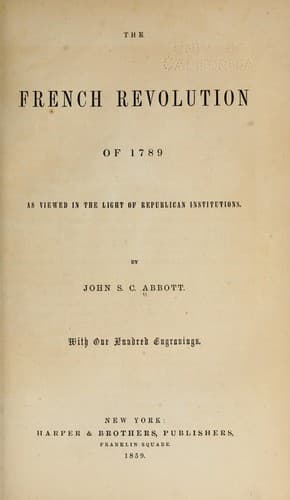
The French Revolution of 1789, as Viewed in the Light of Republican InstitutionsAbbott, John S. C. (John Stevens Cabot)
History
The French Revolution of 1789, as Viewed in the Light of Republican Institutions
Abbott, John S. C. (John Stevens Cabot)
France -- History -- Revolution, 1789-1799
"The queen said to me," writes Madame Campan, "that La Fayette was
offered to them as a resource, but that it would be better for them to
perish than to owe their safety to a man who had done them the most
mischief, or to place themselves under the necessity of treating with
him."--_Mémoires of Marie Antoinette, by Madame Campan_, vol. ii., p.
223.]
[Footnote 333: Thiers, vol. i., p. 278.]
[Footnote 334: "The king had committed himself, on the subject of
the Constitution, to the allied powers, in the instructions he had
given to Mallet du Pan, and was no longer at liberty, even if he had
been disposed, on account of any such object as the Constitution, to
have united himself with La Fayette, not even though La Fayette was
endeavoring to accomplish the great point, of all others to be most
desired, the overthrow of the Girondists and the Jacobins. On the
whole, the court must be considered as now preferring the chance of
the invasion of the allied powers, and the king the chance of some
mediation between them and the people of France, that is, the chance
of better terms than the Constitution offered. This must, I think, be
supposed the line of policy that was now adopted. It was one full of
danger, and, on the whole, a mistake; but with the expectation that
was then so generally entertained of the certain success of the allied
powers, a mistake not unnatural."--_Prof. Smyth's Lectures_, vol. ii.,
p. 295.]
[Footnote 335: Hist. Phil. de la Rev. de Fr., par Ant. Fantin
Desodoards, t. ii., p. 45.]
[Footnote 336: "A court apparently in concert with the enemy resorted
to no means for augmenting the armies and exciting the nation, but,
on the contrary, employed the _veto_ to thwart the measures of the
legislative body, and the _civil list_ (the king's salary) to secure
partisans in the interior."--_Thiers_, vol. i., p. 280.]
[Footnote 337: Madame Campan, vol. ii., p. 230.]
[Footnote 338: "It becomes evident that a republic was desired only
from despair of the monarchy, that it never was a fixed fact, and that,
on the very eve of attaining it, those who were accused of having long
paved the way to it, would not sacrifice the public weal for its sake,
but would have consented to a constitutional monarchy, if it were
accompanied with sufficient safeguards."--_Thiers_, vol. i., p. 308.]
[Footnote 339: M. Brissot was a lawyer of considerable literary
distinction, who, when but twenty years of age, had been imprisoned in
the Bastille for some of his political writings. He was a passionate
admirer of the Americans, and despairing, in consequence of the
fickleness or treachery of the king, of a constitutional monarchy,
endeavored to secure for France a republic. About a year from the time
of the above speech he perished with the rest of the Girondists upon
the scaffold.--_Biographe Moderne._]
CHAPTER XXVII.
THE THRONE DEMOLISHED.
Public-domain text, read in full here on John Shaqi.
Reviews
Reviews
No reviews yet
Be the first to share your thoughts on this work.
Elsewhere in the archive
Join the Discussion
Join the discussion
Sign in to leave a comment or review.
Sign InorCreate an account