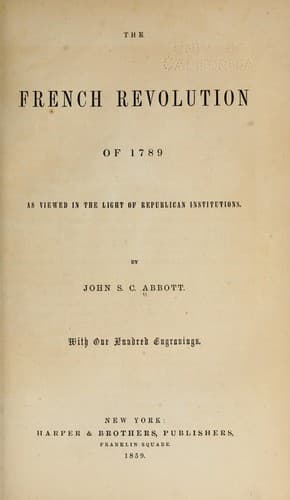
The French Revolution of 1789, as Viewed in the Light of Republican InstitutionsAbbott, John S. C. (John Stevens Cabot)
History
The French Revolution of 1789, as Viewed in the Light of Republican Institutions
Abbott, John S. C. (John Stevens Cabot)
France -- History -- Revolution, 1789-1799
The Country proclaimed in Danger.--Plan of La Fayette for the
Safety of the Royal Family.--Measures of the Court.--Celebration
of the Demolition of the Bastille.--Movement of the Allied
Army.--Conflicting Plans of the People.--Letter of the Girondists to
the King.--Manifesto of the Duke of Brunswick.--Unpopularity of La
Fayette.--The Attack upon the Tuileries, Aug. 10th.--The Royal Family
take Refuge in the Assembly.
The danger to which the country was exposed had now united
Constitutionalists and Republicans, or rather had compelled most of
the Constitutionalists to become Republicans. A patriotic bishop,
whose soul was glowing with the spirit of true Christian fraternity,
addressed the Assembly in an appeal so moving, that, like reconciled
brothers, the two parties rushed into each other's arms to unite in the
defense of that liberty which was equally dear to them all.
On the 11th of July the solemn proclamation was made with great pomp
through the streets of Paris and of France, that _the country was in
danger_. Minute guns were fired all the day. The bells tolled, and the
reveille was beat in all quarters of the city summoning the National
Guard to their posts. A cavalcade of horse paraded the streets with
a large banner containing the inscription, _Citizens, the country is
in danger_. At all the principal places the cortège? halted and the
legislative decree was read. Rendezvous were established in all parts
of the city for the enlistment of volunteers. Unparalleled enthusiasm
pervaded all classes. In Paris alone fifteen thousand were enrolled the
first day.
Petitions were poured in upon the Assembly from all parts of the empire
declaring that the king had forfeited the crown, and demanding his
dethronement. This sudden change, these bold utterances, threw the
court into consternation. The king's life now was in imminent peril,
and he resolved if possible to effect his escape. Several plans were
suggested which seemed to him, with his constitutional feebleness of
purpose, too hazardous to be undertaken. La Fayette, with generous
credulity, still tried to believe the king sincere in his acceptance
of constitutional liberty, and he proposed a plan which would have
saved the king and would have saved France had there been a particle
of sincerity in the bosom of the monarch. It was most noble in La
Fayette thus to forget the insults he had received from the court, and
to peril his life in the endeavor to save a family who had only loaded
him with injuries. His plan, boldly conceived, was as patriotic as it
was humane, and needed but sincerity on the part of the king to secure
its triumphant execution. It was an amiable weakness on the part of La
Fayette still to believe that the king could by any possibility be led
to espouse the Revolution. His proposition was briefly this:
[Illustration: THE COUNTRY PROCLAIMED IN DANGER.]
Public-domain text, read in full here on John Shaqi.
Reviews
Reviews
No reviews yet
Be the first to share your thoughts on this work.
Elsewhere in the archive
Join the Discussion
Join the discussion
Sign in to leave a comment or review.
Sign InorCreate an account