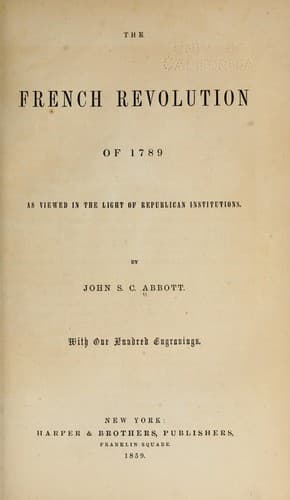
The French Revolution of 1789, as Viewed in the Light of Republican InstitutionsAbbott, John S. C. (John Stevens Cabot)
History
The French Revolution of 1789, as Viewed in the Light of Republican Institutions
Abbott, John S. C. (John Stevens Cabot)
France -- History -- Revolution, 1789-1799
"General Luckner and I," said he to the king, "will come to Paris to
attend the celebration of the demolition of the Bastille on the 14th
of July. In company with us, the next day, the king with his family
shall visit Compiègne, fifty miles north of Paris. The people will
have sufficient confidence in us to make no opposition. Should there
be opposition we will have a sufficient force of dragoons at hand to
strike by surprise and release you. Ten squadrons of horse-artillery
shall there receive the monarch and conduct him to the army on
the frontiers. The king shall then issue a decided proclamation
forbidding his brothers and the emigrants to advance another step
toward the invasion of France, declaring, in terms which can not be
misinterpreted, his determination to maintain the Constitution, and
announcing his readiness to place himself at the head of the army to
repel the enemy. This decisive measure will satisfy France that the
king is its friend not its foe. The allies can make no headway against
France united under its monarch. The king can then return triumphant to
Paris, amid the universal acclamations of the people, a constitutional
monarch beloved and revered by his subjects."[340]
This was the wisest course which, under the circumstances, could
possibly have been pursued. It was constitutional. It would have been
the salvation of the king and of France. Many of the king's personal
friends entreated him, with tears, to repose confidence in La Fayette,
and to comply with the counsels of the only man who could rescue him
from destruction. But the fickle-minded king was now in the hands
of the queen and the courtiers, and was guided at their pleasure.
All their hopes were founded in the re-establishment of despotism by
foreign invasion. The generous plan of La Fayette was rejected with a
cold and almost insulting repulse.
"The best advice," replied the king, "which can be given to La Fayette
is to continue to serve as a bugbear to the factions by the able
performance of his duty as a general."
The queen was so confident that in a few weeks the allied armies
would be in Paris, and that any acts of disrespect on the part of the
people would only tend to hasten their march, that when Colombe, the
aid-de-camp of La Fayette, remonstrated against the infatuation of so
fatal a decision, she replied, "We are much obliged to your general for
his offer, but the best thing which could happen to us would be to be
confined for two months in a tower."
When La Fayette was thus periling his life to save the royal family he
knew that, by the queen's orders, pamphlets filled with calumny were
composed against him, and were paid for out of the king's salary.[341]
Public-domain text, read in full here on John Shaqi.
Reviews
Reviews
No reviews yet
Be the first to share your thoughts on this work.
Elsewhere in the archive
Join the Discussion
Join the discussion
Sign in to leave a comment or review.
Sign InorCreate an account