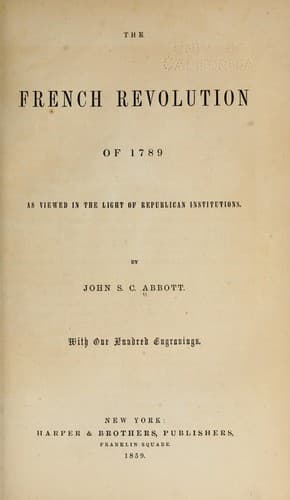
The French Revolution of 1789, as Viewed in the Light of Republican InstitutionsAbbott, John S. C. (John Stevens Cabot)
History
The French Revolution of 1789, as Viewed in the Light of Republican Institutions
Abbott, John S. C. (John Stevens Cabot)
France -- History -- Revolution, 1789-1799
The friends of liberty now saw no possible way of rescuing France
from its peril and of saving themselves from the scaffold, but by
wresting the executive power from the king and the court, who were in
co-operation with the foe. This could only be done by a _revolution_,
for the Constitution conferred no right upon the Assembly to dethrone
the king. The Girondists or moderate Republicans, detesting the
Jacobins and appalled in view of the anarchy which would ensue from
arming the mob of Paris, wished to have the _Assembly_ usurp the power
and dethrone the king. The Jacobins, who hoped to ride into authority
upon the waves of popular tumult, deliberately resolved to demolish the
throne by hurling against it the infuriate masses of the people. It was
calling into action the terrible energies of the earthquake and the
tornado, knowing that their ravages, once commenced, could be arrested
by no earthly power.
The plan first formed was to rouse the people in resistless numbers,
march upon the Tuileries, take the king a prisoner, and hold him in the
Castle of Vincennes as a hostage for the good conduct of the emigrants
and the allies. The appointed day came, and Paris was thrown into a
state of terrible confusion. But the court had been admonished of the
movement. The palace was strongly defended, and in consequence of some
misunderstanding it was found that there was not sufficient concert of
action to attempt the enterprise.
A new scheme was now formed, energetic and well-adapted to the
effectual accomplishment of its purpose. At the ringing of the tocsin
forty thousand men were to be marshaled in the faubourg St. Antoine.
Another immense gathering of the populace was to rally in the faubourg
St. Marceau. All the troops in the metropolis from the provinces were
to be arrayed at the encampment of the Marseilles battalion. They were
then to march simultaneously to the palace, fill the garden and the
court of the Carrousel, and invest the Tuileries on all sides. Here
they were to encamp with all the enginery of war, and fortify their
position by ditches, barricades, and redoubts. No blood was to be shed.
There was to be no assault upon the palace, and no forcible entry. The
king was to be blockaded, and the Assembly was to be informed that the
populace would not lay down their arms until the king was dethroned,
and the Legislature had adopted measures to secure the safety of the
country.[344] In this plan there was something generous and sublime. It
endeavored to guard carefully against disorder, pillage, and blood. It
was the majestic movement of the people rising in self defense against
its own executive in combination with foreign foes. Barbaroux, the
leader of the Marseillese, sketches this plan in pencil. It was copied
by Fournier, and adopted by Danton and Santerre.[345]
Public-domain text, read in full here on John Shaqi.
Reviews
Reviews
No reviews yet
Be the first to share your thoughts on this work.
Elsewhere in the archive
Join the Discussion
Join the discussion
Sign in to leave a comment or review.
Sign InorCreate an account