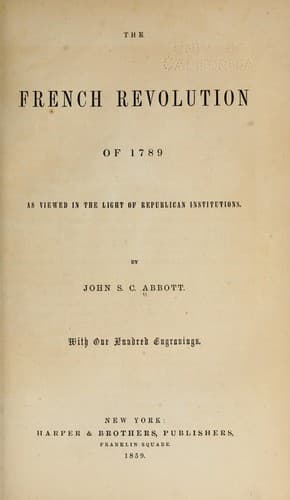
The French Revolution of 1789, as Viewed in the Light of Republican InstitutionsAbbott, John S. C. (John Stevens Cabot)
History
The French Revolution of 1789, as Viewed in the Light of Republican Institutions
Abbott, John S. C. (John Stevens Cabot)
France -- History -- Revolution, 1789-1799
Several of the leaders of the Girondists, anxious to avert the fearful
crisis now impending, wrote a noble letter to the king containing
considerations just and weighty, which ought to have influenced him to
corresponding action. The letter was written by Vergniaud, Gaudet, and
Gensonné, three of the brightest ornaments of the Legislative Assembly.
"It ought not to be dissembled," said these men to the king, "that it
is the conduct of the executive power that is the immediate cause of
all the evils with which France is afflicted, and of the dangers with
which the throne is surrounded. They deceive the king who would lead
him to suppose that it is the effervesence of the clubs, the manoeuvres
of particular agitators and powerful factions that have occasioned and
continued those disorderly movements, of which every day increases the
violence, and of which no one can calculate the consequences. Thus to
suppose is to find the cause of the evil in what are only the symptoms.
The only way to establish the public tranquillity is for the king to
surround himself with the confidence of his people. This can only be
done by declaring, in the most solemn manner, that he will receive
no augmentation of his power that shall not be freely and regularly
offered him by the French nation without the assistance or interference
of any foreign powers.
"What would be, perhaps, sufficient at once to re-establish confidence
would be for the king to make the coalesced powers acknowledge the
independence of the French nation, cease from all farther hostilities,
and withdraw the troops that menace our frontiers. It is impossible
that a very great part of the nation should not be persuaded that the
king has it in his power to put an end to the coalition; and while that
coalition continues and places the public liberty in a state of peril,
it is in vain to flatter the king that confidence can revive."
The court regarded this letter as insolent, and the king returned an
answer which declared that he should pay no attention whatever to its
suggestions.
Public-domain text, read in full here on John Shaqi.
Reviews
Reviews
No reviews yet
Be the first to share your thoughts on this work.
Elsewhere in the archive
Join the Discussion
Join the discussion
Sign in to leave a comment or review.
Sign InorCreate an account