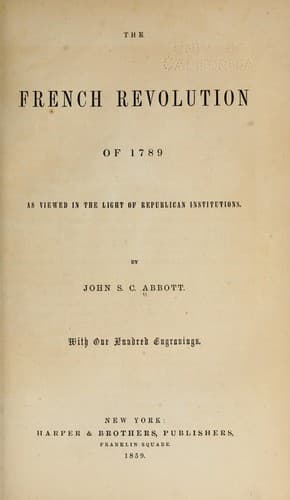
The French Revolution of 1789, as Viewed in the Light of Republican InstitutionsAbbott, John S. C. (John Stevens Cabot)
History
The French Revolution of 1789, as Viewed in the Light of Republican Institutions
Abbott, John S. C. (John Stevens Cabot)
France -- History -- Revolution, 1789-1799
This ferocious document was printed in all the Royalist papers in
Paris on the 28th of July. The king immediately issued a message
disavowing any agency in the manifesto. But the people no longer had
any confidence in the word of the king. Paris was thrown into a state
of terrible agitation. The forty-eight sections of Paris met, and
commissioned the mayor, Pétion, to appear before the General Assembly,
and petition, in their name, the dethronement of the king. On the 3d
of August, Pétion, at the head of a numerous deputation, presented
himself before the Assembly. In an address, calm, unimpassioned, but
terrible in its severity, he retraced the whole course of the king from
the commencement of the Revolution, and closed with the solemn demand
for the dethronement of Louis XVI., as the most dangerous enemy of the
nation. The Assembly was embarrassed by its desire to adhere to the
Constitution which it had sworn to obey. The dethronement of the king
was not a _constitutional_ but a _revolutionary_ act. A long and stormy
debate ensued, during which the hall was flooded with petitions against
the king. The king's friends were again intensely anxious to secure his
escape. But the king would not listen to their plans, for he was so
infatuated as to believe that the Duke of Brunswick would soon, by an
unimpeded march, be in Paris for his rescue.
The sympathy which La Fayette had manifested for the royal family
had now ruined him in the esteem of the populace. He was every where
denounced as a traitor, and a strong effort was made to compel the
Assembly to indite a bill of accusation against him. But La Fayette's
friends in the chamber rallied, and he was absolved from the charge of
treason by a vote of four hundred and forty-six against two hundred
and eighty. The populace was so exasperated by this result that they
heaped abuse upon all who voted in his favor, and several of them were
severely maltreated by the mob. The National Assembly had now become
unpopular. It was ferociously denounced in the club of the Jacobins and
in all the corners of the streets. In the mean time the insurrectionary
committee, formed from the Jacobin club, were busy in preparation for
the great insurrection. All hearts were appalled, for all could see
that a cloud of terrific blackness was gathering, and no one could tell
what limit there would be to the ravages of the storm.
Public-domain text, read in full here on John Shaqi.
Reviews
Reviews
No reviews yet
Be the first to share your thoughts on this work.
Elsewhere in the archive
Join the Discussion
Join the discussion
Sign in to leave a comment or review.
Sign InorCreate an account