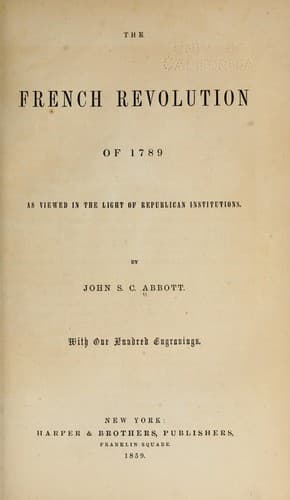
The French Revolution of 1789, as Viewed in the Light of Republican InstitutionsAbbott, John S. C. (John Stevens Cabot)
History
The French Revolution of 1789, as Viewed in the Light of Republican Institutions
Abbott, John S. C. (John Stevens Cabot)
France -- History -- Revolution, 1789-1799
At midnight, on the 9th of August, the dismal sound of the tocsin was
heard. From steeple to steeple the boding tones floated through the
dark air. A thousand drums beat the alarm at the appointed rendezvous,
and the booming of guns shook the city. In an hour all Paris was in
tumult. The clatter of iron hoofs, the rumbling of heavy artillery,
the tramp of disciplined battalions, and the rush and the clamor of a
phrensied mob, presented the most appalling scene of tumult and terror.
A city of a million and a half of inhabitants was in convulsions. The
friends of the king hurried to the palace, announcing with pale lips
that the terrible hour had come. The event needed no announcement, for
the whole city was instantly trembling beneath earthquake throes. The
king, the queen, the two children, and Madame Elizabeth had assembled
tremblingly in one of the rooms of the palace, as lambs huddle together
when wolves are howling round the fold. Marie Antoinette was imperially
brave, but she could not in that hour look upon her helpless son and
daughter and not feel her maternal heart sink within her. Louis XVI.
had the endurance of a martyr, but he could not, unmoved, contemplate
the woes of his family.
The friends of the king speedily rallied, and brought up all their
forces for his defense. The apartments of the palace were filled with
Royalist gentlemen armed with swords, pistols, and even with shovels
and tongs. Nine hundred Swiss guards, upon whom it was thought reliance
could be reposed, were placed on the stairs, in the halls, and the
large saloons. Six or eight hundred mounted dragoons were in one of the
court-yards. Several battalions of the National Guard, who were most
friendly to the king, were stationed in the garden with twelve pieces
of artillery.[347] The defenders of the palace amounted in all to about
four or five thousand men. But many of these were very lukewarm in
their loyalty, and might at any moment be expected to fraternize with
the populace.[348]
Public-domain text, read in full here on John Shaqi.
Reviews
Reviews
No reviews yet
Be the first to share your thoughts on this work.
Elsewhere in the archive
Join the Discussion
Join the discussion
Sign in to leave a comment or review.
Sign InorCreate an account