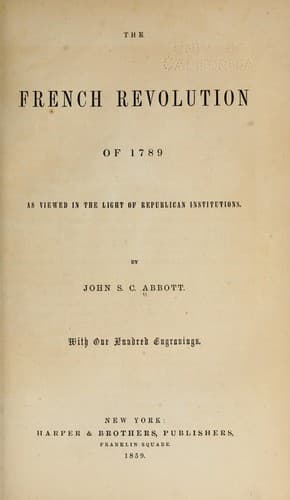
The French Revolution of 1789, as Viewed in the Light of Republican InstitutionsAbbott, John S. C. (John Stevens Cabot)
History
The French Revolution of 1789, as Viewed in the Light of Republican Institutions
Abbott, John S. C. (John Stevens Cabot)
France -- History -- Revolution, 1789-1799
Pétion, the mayor, was sent for. He came, and after an awkward
interview retired, leaving Mandat, who was general-in-chief of the
National Guard, commander of the troops at the Tuileries. It was a
sultry night. Every window at the Tuileries was thrown open, and the
inmates listened anxiously to the uproar which rose from every part
of the city. The queen and Madame Elizabeth ascended to a balcony
opening from one of the highest stories of the palace. The night was
calm and beautiful, the moon brilliant in the west, and Orion and the
Pleiades shining serenely in the east.[349] There the queen and the
princess stood for some time, trembling and in silence as the peal of
bells, the clangor of drums, the rumbling of artillery wheels, and the
shouts of the advancing bands, filled the air. From every direction,
the east, the west, the north and the south, the portentous booming
of the tocsin was heard, and infuriated insurgents, in numbers which
could not be counted, through all the streets and avenues, were pouring
toward the palace. The bridges crossing the river echoed with their
tread, while the blaze of bonfires and the gleam of torches added to
the appalling sublimities of the scene.[350]
The queen broke the silence. Pointing to the moon she said, "Before
that moon returns again, either the allies will be here and we shall be
rescued, or I shall be no more. But let us descend to the king."
The spectacle seemed but to have aroused the energies of Marie
Antoinette. The spirit of her imperial mother glowed in her bosom.[351]
Her cheeks were pale as death, her lips were compressed, her eyes
flashed fire, and, as she returned to the room where her husband stood
bewildered and submissive to his lot, she approached a grenadier, drew
a pistol from his belt, and, presenting it to her husband, said,
"Now, sire! now is the time to show yourself a king."
But Louis XVI. was a quiet, patient, enduring man, with nothing
imperial in his nature. With the most imperturbable meekness he took
the pistol and handed it back to the grenadier. The mayor, Pétion, an
active member of the Jacobin Club, had manifested no disposition to
render effectual aid in the defense of the palace. But lest it should
seem that he was heading the mob, he had reluctantly signed an order,
as he left the Tuileries, authorizing the employment of force to repel
force.
Public-domain text, read in full here on John Shaqi.
Reviews
Reviews
No reviews yet
Be the first to share your thoughts on this work.
Elsewhere in the archive
Join the Discussion
Join the discussion
Sign in to leave a comment or review.
Sign InorCreate an account