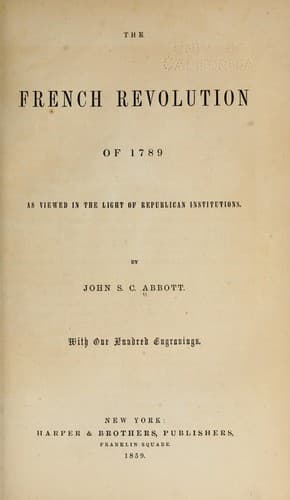
The French Revolution of 1789, as Viewed in the Light of Republican InstitutionsAbbott, John S. C. (John Stevens Cabot)
History
The French Revolution of 1789, as Viewed in the Light of Republican Institutions
Abbott, John S. C. (John Stevens Cabot)
France -- History -- Revolution, 1789-1799
The appearance of the queen in this terrible hour riveted every eye and
excited even the enthusiasm of her foes. Her flushed cheek, dilated
nostril, compressed lip, and flashing eye invested her with an imperial
beauty almost more than human. Her head was erect, her carriage proud,
her step dignified, and she looked around her upon applauding friends
and assailing foes with a majesty of courage which touched every heart.
Even the most ardent patriots forgot for the moment their devotion
to liberty in the enthusiasm excited by the heroism of the queen.
Re-entering the palace, the queen, in despair, ascended the stairs to
the saloon, saying,
"All is lost. The king has shown no energy. A review like this has done
us more harm than good."
The king, however, instead of ascending to his apartment, passed
through the palace into the Garden to ascertain the disposition of
the troops stationed there. With his small retinue he traversed the
whole length of the Garden. Some of the battalions received him
with applause, others were silent, while here and there voices in
continually increasing numbers cried, "_Down with the veto; down with
the tyrant_." As the king turned to retrace his steps, menaces and
insults were multiplied. Some of the gunners even left their guns and
thrust their fists in his face, assailing him with the most brutal
abuse. The clamor penetrated the interior of the palace and the queen,
turning pale as death, sank into a chair, exclaiming,
"Great God! they are hooting the king. We are all lost."
The king returned to the palace, pale, exhausted, perspiring at every
pore, and overwhelmed with confusion and shame. He immediately retired
to his cabinet. Roederer,[353] chief magistrate of the Department of
the Seine, who had witnessed the hostile disposition of the troops,
now hastened to the chateau and asked permission to speak to his
majesty in private, with no witnesses but the royal family. He entered
the royal cabinet and found the king with his elbows resting on his
knees and his face buried in his hands. All retired but the royal
family and the king's ministers.
"Sire," said M. Roederer, "you have not a moment to lose. Neither the
number nor the disposition of the men here assembled can guarantee your
life or the lives of your family. There is no safety for you but in the
bosom of the Assembly."
The hall of the Assembly was in the old monastery of the Feuillants,
situated on the western side of the Garden, where the Rue de Rivoli
now runs. The royal family could consequently descend into the Garden,
which was filled with troops collected there for their defense, and
crossing the Garden could enter the hall with but little exposure.
But such a refuge to the high-spirited queen was more dreadful than
death. It was draining the cup of humiliation to its dregs.
Public-domain text, read in full here on John Shaqi.
Reviews
Reviews
No reviews yet
Be the first to share your thoughts on this work.
Elsewhere in the archive
Join the Discussion
Join the discussion
Sign in to leave a comment or review.
Sign InorCreate an account