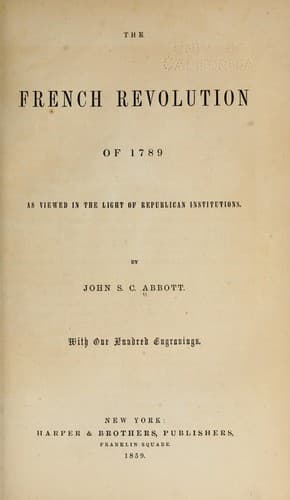
The French Revolution of 1789, as Viewed in the Light of Republican InstitutionsAbbott, John S. C. (John Stevens Cabot)
History
The French Revolution of 1789, as Viewed in the Light of Republican Institutions
Abbott, John S. C. (John Stevens Cabot)
France -- History -- Revolution, 1789-1799
"Go to the Assembly!" exclaimed the queen; "never! never will I take
refuge there. Rather than submit to such infamy I would prefer to be
nailed to the walls of the palace."
"It is there only," M. Roederer replied, "that the royal family can
be in safety. And it is necessary to escape immediately. In another
quarter of an hour, perhaps, we shall not be able to command a retreat."
"What," rejoined the queen, "have we no defenders? Are we alone?"
"Yes, madame," replied Roederer, "we are alone. The troops in the
Garden and in the court are fraternizing with your assailants and
turning their guns against the palace. All Paris is on the march.
Action is useless. Resistance is impossible."
A gentleman present, who had been active in promoting reform, ventured
to add his voice in favor of an immediate retreat to the Assembly. The
queen turned upon him sternly, and said,
"Silence, sir, silence! It becomes you to be silent here. When the
mischief is done, those who did it should not pretend to wish to remedy
it."[354]
M. Roederer resumed, saying, "Madame, you endanger the lives of your
husband and your children. Think of the responsibility which you take
upon yourself."
The king raised his head, fixed a vacant stare of anguish for a moment
on M. Roederer, and then, rising, said, "Marchons" (_Let us go_).
The queen, unable any longer to shut her eyes to the fatality, turning
to M. Roederer, eagerly added, "You, sir, are answerable for the life
of the king and for that of my son."
"Madame," M. Roederer replied, "we undertake to die by your side, but
that is all we can promise." It was then eight o'clock in the morning.
A guard of soldiers was instantly called in, and the melancholy cortège
left the palace. The Swiss troops and the loyalist gentlemen, who
filled the apartments, looked on in consternation and despair. There
was no apparent escape for them, and they seemed to be abandoned to
their fate. As the king was crossing the threshold he thought of his
friends, and his heart seemed to misgive him. He hesitated, stopped,
and, turning to M. Roederer, said, "What is to become of our friends
who remain behind?" M. Roederer pacified the king by assuring him,
though falsely, that by throwing aside their arms and their uniform
they would be able to escape in safety.
They then entered the Garden and crossed it, unopposed, between the
two files of bayonets. The leaves of autumn strewed the paths, and the
young dauphin amused himself in kicking them as he walked along. It is
characteristic of the mental infirmities of the king that in such an
hour he should have remarked, "There are a great many leaves. They fall
early this year."
Public-domain text, read in full here on John Shaqi.
Reviews
Reviews
No reviews yet
Be the first to share your thoughts on this work.
Elsewhere in the archive
Join the Discussion
Join the discussion
Sign in to leave a comment or review.
Sign InorCreate an account