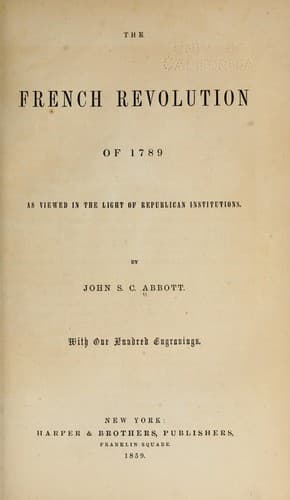
The French Revolution of 1789, as Viewed in the Light of Republican InstitutionsAbbott, John S. C. (John Stevens Cabot)
History
The French Revolution of 1789, as Viewed in the Light of Republican Institutions
Abbott, John S. C. (John Stevens Cabot)
France -- History -- Revolution, 1789-1799
Her power soon became unlimited and invincible, for her heart was of
iron, and even her feminine hand could wield all the terrors of court
banishment, confiscation, exile, and the Bastille. It is said that a
witticism of Frederic II. of Prussia, at her expense, plunged France
into all the horrors of the Seven Years' War. The most high-born ladies
in the land were her waiting-women. Her steward was a knight of the
order of St. Louis. When she rode out in her sedan-chair, the Chevalier
d'Hénin, a member of one of the noblest families of the kingdom, walked
respectfully by her side, with her cloak upon his arm, ready to spread
it over her shoulder whenever she should alight.
She summoned embassadors before her, and addressed them with the
regal _we_, assuming the style of royalty. She appointed bishops and
generals, and filled all the important offices of Church and State with
those who would do her homage. She dismissed ministers and created
cardinals, declared war and made peace. Voltaire paid court to her,
and devoted his muse to the celebration of her beauty and her talents.
Montesquieu, Diderot, and Quesnay waited in her antechamber, imploring
her patronage. Those authors who pleased her she pensioned and honored;
those who did not were left in poverty and neglect. Even the imperial
Maria Theresa, seeking the alliance of France, wrote to her with her
own hand, addressing her as her "dear friend and cousin." "Not only,"
said Madame de Pompadour one day to the Abbé de Bernis, "not only have
I all the nobility at my feet, but even my lap-dog is weary of their
fawnings." Rousseau, strong in the idolatry of the nation, refused to
join the worshipers at the shrine of Pompadour. She dared not send
_him_ to the Bastille, but vexatiously exclaimed "I will have nothing
more to do with that _owl_."
As Madame de Pompadour found her charms waning, she maintained her
place by ministering to the king's appetites in the establishment of
the most infamous institution ever tolerated in a civilized land.
Lacretelle, in his History of France, thus describes this abomination:
"Louis XV., satiated with the conquests which the court offered him,
was led by a depraved imagination to form an establishment for his
pleasures of such an infamous description that, after having depicted
the debaucheries of the regency, it is difficult to find terms
appropriate to an excess of this kind. Several elegant houses, built
in an inclosure called the _Parc aux Cerfs_, near Versailles, were
used for the reception of beautiful female children, who there awaited
the pleasure of their master. Hither were brought young girls, sold
by their parents, and sometimes forced from them. It was skillfully
and patiently fostered by those who ministered to the profligacy of
Louis; whole years were occupied in the debauchery of girls not yet in
a marriageable age, and in undermining the principles of modesty and
fidelity in young women."
Public-domain text, read in full here on John Shaqi.
Reviews
Reviews
No reviews yet
Be the first to share your thoughts on this work.
Join the Discussion
Join the discussion
Sign in to leave a comment or review.
Sign InorCreate an account