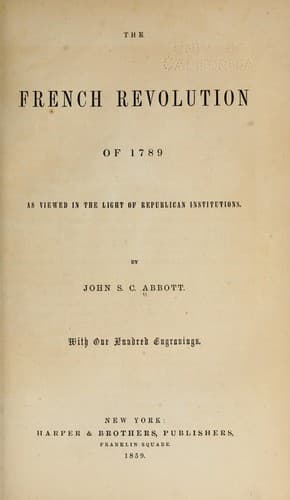
The French Revolution of 1789, as Viewed in the Light of Republican InstitutionsAbbott, John S. C. (John Stevens Cabot)
History
The French Revolution of 1789, as Viewed in the Light of Republican Institutions
Abbott, John S. C. (John Stevens Cabot)
France -- History -- Revolution, 1789-1799
Emboldened by the sympathy of the people in this conflict with the
court, the Parliament ventured to enter upon its records a remonstrance
against the violent procedure; and, to gain still more strength from
popular approval, they made the strange assertion that Parliament was
not competent to register tax edicts at all; that for this act the
authority of the three estates of the realm was essential, convened
in the States-General. This was, indeed, unheard of doctrine, for the
Parliament had for centuries registered such decrees. It, however,
answered its purpose; it brought the masses of the people at once and
enthusiastically upon their side.
This call for the States-General was the first decisive step toward
bringing the people into the field. Tumultuous crowds surrounded the
palace where the Parliament held its session, and with clapping of
hands and shouts received the tidings of the resolutions adopted. The
king, indignant, issued _letters de cachet_ on the night of the 14th,
and the next morning the whole body was arrested and taken in carriages
into banishment to Troyes, a dull city about one hundred miles from
Paris. The blessings of the people followed the Parliament;[62] "for
there are quarrels," says Carlyle, "in which even Satan, bringing help,
were not unwelcome."
Paris was now in a state of commotion. Defiant placards were posted
upon the walls, and there were angry gatherings in the streets. The
two brothers of the king, subsequently Louis XVIII. and Charles X.,
entered Paris in state carriages to expunge from the records of the
Parliament the obnoxious protests and resolutions. They came with a
well-armed retinue. The stormy multitudes frowned and hissed, and were
only dispersed by the gleam of the sword.
For a month Parliament remained at Troyes, excessively weary of exile.
In the mean time Brienne had no money, and could raise none. Both
parties were ready for accommodation. The crown consented to relinquish
the _tax upon the nobles_, and to summon the States-General in five
years. Parliament consented to register an edict for a _loan_ of one
hundred millions of dollars, the burden of which was to fall upon the
_people_ alone. With this arrangement the exiled Parliament was brought
back on the 20th of September. "It went out," said D'Espréménil,
"covered with glory. It came back covered with mud."
On the 20th of September the king appeared before the Parliament in
person, to present the edict for the loan and the promise to convoke
the States-General at the close of five years.
Public-domain text, read in full here on John Shaqi.
Reviews
Reviews
No reviews yet
Be the first to share your thoughts on this work.
Elsewhere in the archive
Join the Discussion
Join the discussion
Sign in to leave a comment or review.
Sign InorCreate an account