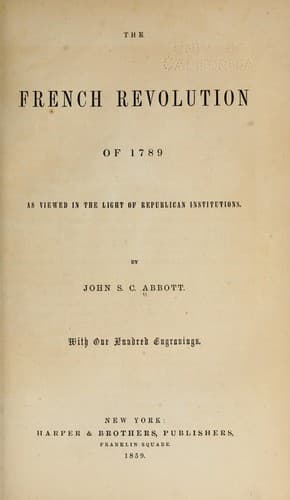
The French Revolution of 1789, as Viewed in the Light of Republican InstitutionsAbbott, John S. C. (John Stevens Cabot)
History
The French Revolution of 1789, as Viewed in the Light of Republican Institutions
Abbott, John S. C. (John Stevens Cabot)
France -- History -- Revolution, 1789-1799
And now the parliaments which had been organized in many of the
provinces made common cause with the Parliament of Paris, and sent
in their remonstrances against the despotism of the crown. Gloom now
pervaded the saloons of Versailles. Marie Antoinette, with pale cheek
and anxious brow, wandered through the apartments dejected and almost
despairing. Groves and gardens surrounded her embellished with flowers
and statues and fountains. The palace which was her home surpassed
in architectural grandeur and in all the appliances of voluptuous
indulgence any abode which had ever before been reared upon earth.
Obsequious servants and fawning courtiers anticipated her wishes, and
her chariot with its glittering outriders swept like a meteor through
the enchanting drives which art, aided by the wealth of a realm, had
constructed, and yet probably there was not a woman in the whole realm,
in garret or hut or furrowed field, who bore a heavier heart than that
which throbbed within the bosom of the queen. The king was a harmless,
inoffensive, weak-minded man, spending most of his time at the forge.
It was well understood that the queen, energetic and authoritative,
was the real head of the government, and that every act of vigor
originated with her. She consequently became peculiarly obnoxious to
the Parliament, and through them to the people; and Paris was flooded
with the vilest calumnies against her.
There was at that time fluttering about Versailles a dissolute woman
of remarkable beauty, the Countess Lamotte. She forged notes against
the queen, and purchased a very magnificent pearl necklace at the price
of three hundred thousand dollars. Cardinal Rohan was involved in the
intrigue. The transaction was noised through all Europe. The queen was
accused of being engaged in a swindling transaction with a profligate
woman to cheat a jeweler, and was also accused of enormous extravagance
in wishing to add to the already priceless jewels of the crown others
to the amount of three hundred thousand dollars. The queen was
innocent; but the public mind exasperated wished to believe all evil
of her. Men, haggard and hungry, and without employment; women ragged
and starving, and with their starving children in their arms, were ever
repeating the foul charge against the queen as a thief, an accomplice
with a prostitute, one who was willing to see the people starve if she
might but hang pearls about her neck. The story was so universally
credited, and created such wide-spread exasperation, that Talleyrand
remarked, "Mind that miserable affair of the necklace. I should be
nowise surprised if it should overturn the French monarchy."
Public-domain text, read in full here on John Shaqi.
Reviews
Reviews
No reviews yet
Be the first to share your thoughts on this work.
Elsewhere in the archive
Join the Discussion
Join the discussion
Sign in to leave a comment or review.
Sign InorCreate an account