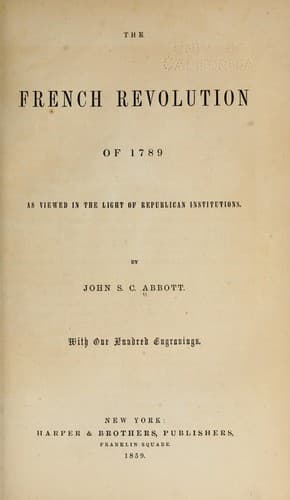
The French Revolution of 1789, as Viewed in the Light of Republican InstitutionsAbbott, John S. C. (John Stevens Cabot)
History
The French Revolution of 1789, as Viewed in the Light of Republican Institutions
Abbott, John S. C. (John Stevens Cabot)
France -- History -- Revolution, 1789-1799
In addition to all this the report was spread abroad that the children
of Marie Antoinette were illegitimate; that the king had not sufficient
capacity to reign; that his next brother, called Monsieur, subsequently
Louis XVIII., was engaged in a conspiracy with the Parliament to eject
Louis XVI. from the throne, and to establish a government of the
nobles, of which Monsieur should be the nominal head. It is by no means
improbable that this plan was formed. It will account for many of the
actions of the nobles during the first stages of the Revolution.[69]
The second brother of the king, Count d'Artois, a very elegant and
accomplished man of fashion, fond of pleasure, and with congenial
tastes with the young and beautiful queen, was accused, though probably
without foundation, of being her paramour and the father of her
children. He had erected, just outside the walls of Paris, in the woods
of Boulogne, a beautiful little palace which he called _Bagatelle_.
This was the seat of the most refined voluptuousness and of the most
costly indulgence.
The queen now knew not which way to turn from the invectives which were
so mercilessly showered upon her. It was in vain to attempt an answer.
Her lofty spirit so far sustained her as to enable her in public to
appear with dignity. But in her boudoir she wept in all the anguish
of a crushed and despairing heart. "One morning at Trianon," writes
Madame Campan, "I went into the queen's chamber when she was in bed.
There were letters lying upon her bed and she was weeping bitterly. Her
tears were mingled with sobs, which she occasionally interrupted by
exclamations of '_Ah! that I were dead. Wretches! monsters! what have
I done to them?_' I offered her orange-flower-water and ether. '_Leave
me, if you love me; it would be better to kill me at once._' At this
moment she threw her arm over my shoulder and began weeping afresh."[70]
Public-domain text, read in full here on John Shaqi.
Reviews
Reviews
No reviews yet
Be the first to share your thoughts on this work.
Elsewhere in the archive
Join the Discussion
Join the discussion
Sign in to leave a comment or review.
Sign InorCreate an account