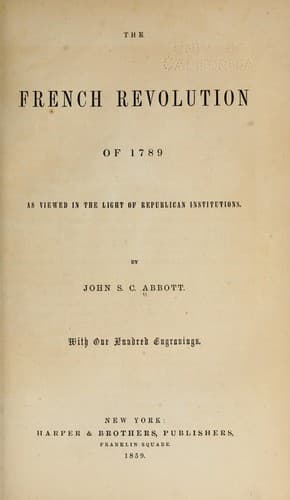
The French Revolution of 1789, as Viewed in the Light of Republican InstitutionsAbbott, John S. C. (John Stevens Cabot)
History
The French Revolution of 1789, as Viewed in the Light of Republican Institutions
Abbott, John S. C. (John Stevens Cabot)
France -- History -- Revolution, 1789-1799
There succeeded this reading at first a universal outbreak of
indignation. They then took an oath to resist, at the peril of their
lives, all measures tending to the overthrow of the old French
parliaments. The tidings that the plot had been detected were borne
speedily to the court at Versailles. Fierce passion now added fury to
the battle. Two _lettres de cachet_ were issued to seize D'Espréménil
and another active member of the opposition, Goislard, and silence
them in the Bastille. Warned of their danger they escaped through
scuttles and over the roofs of houses to the Palace of Justice,
dispatched runners in every direction to summon the members, and
then, laying aside their disguise, assumed their robes of office. An
hour had not elapsed ere Parliament was in session and all Paris in
commotion. Parliament immediately voted that the two members should
not be given up, and that their session was permanent and subject to
no adjournment until the pursuit of the two victims was relinquished.
All the avenues of the Palace of Justice were inundated with a throng
of excited citizens, bewildered by this open and deadly antagonism
between the Parliament and the court. All the day and all the night
and all the next day, for thirty-six hours, the session of stormy
debate and fierce invective continued. Again gloomy night settled down
over sleepless Paris. But suddenly there was heard the roll of drums
and the bugle-blast and the tramp of armed men. Captain d'Agoust, at
the head of the royal troops, marched from Versailles with infantry,
cavalry, and artillery. Sternly and rapidly by torch-light the soldiers
advanced, clearing their way through the multitudes crowding the
court-yards and avenues of the Palace of Justice.[73]
At the head of a file of soldiers with gleaming bayonets and loaded
muskets, D'Agoust, a soldier of cast-iron face and heart, mounted
the stairs, strode with the loud clatter of arms into the hall, and
demanded, in the name of the king, M. Duval d'Espréménil and M.
Goislard de Monsabert. As he did not know these persons he called upon
them to come forward and surrender themselves. For a moment there was
profound silence, and then a voice was heard, "We are all D'Espréménils
and Monsaberts." For a time there was great tumult, as many voices
repeated the cry.
Order being restored, the president inquired whether D'Agoust will
employ violence. "I am honored," the captain replies, "with his
majesty's commission to execute his majesty's order. I would gladly
execute the order without violence, but at all events I shall execute
it. I leave the senate for a few minutes to deliberate which method
they prefer." With his guard he left the hall.
Public-domain text, read in full here on John Shaqi.
Reviews
Reviews
No reviews yet
Be the first to share your thoughts on this work.
Elsewhere in the archive
Join the Discussion
Join the discussion
Sign in to leave a comment or review.
Sign InorCreate an account