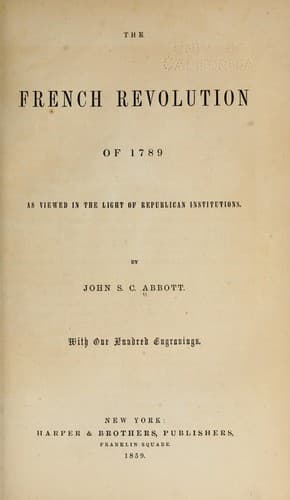
The French Revolution of 1789, as Viewed in the Light of Republican InstitutionsAbbott, John S. C. (John Stevens Cabot)
History
The French Revolution of 1789, as Viewed in the Light of Republican Institutions
Abbott, John S. C. (John Stevens Cabot)
France -- History -- Revolution, 1789-1799
After a brief interval the sturdy captain returned with his well-armed
retinue. "We yield to force," said the two counselors, as they
surrendered themselves. Their brethren gathered around their arrested
companions for a parting embrace, but the soldiers cut short the scene
by seizing them and leading them down, through winding passages, to a
rear gate, where two carriages were in waiting. Each was placed in a
carriage with menacing bayonets at his side. The populace looked on in
silence. They dared not _yet_ speak. But they were learning a lesson.
D'Espréménil was taken to an ancient fortress on one of the Isles
of Hieres, in the Mediterranean, about fourteen miles from Toulon.
Goislard was conveyed to a prison in Lyons.
D'Agoust, having dispatched his prisoners, returned to the Hall of
Assembly, and ordered the members of Parliament to disperse. They were
compelled to file out, one hundred and sixty-five in number, beneath
the bayonets of the grenadiers. D'Agoust locked the doors, put the keys
into his pocket, and, with his battalions, marched back to Versailles.
The Parliament of Paris was now turned into the street. But still there
was no money in the treasury. The provincial parliaments were roused,
and had matured their plans to resist the new courts. The 8th of May
arrived, when the decree, now every where promulgated, was to be put
into execution. The intendants and the king's commissioners found, at
all points, organized opposition. The provincial noblesse united with
the parliaments, for it was now but a struggle of the nobility against
the unlimited power of the crown. A deputation of twelve was sent from
the Parliament of Breton, with a remonstrance, to Versailles. They were
all consigned to the Bastille. A second deputation, much larger, was
sent. Agents of the king met them, and, by menaces, drove them back. A
third, still more numerous, was appointed, to approach Versailles by
different roads. The king refused to receive them. They held a meeting
in Paris, and invited La Fayette and all patriotic Bretons in Paris to
advise with them.[74] This was the origin of the Jacobin Club.
Eight parliaments were exiled. But at Grenoble they refused to
surrender themselves to the _lettres de cachet_. The tocsin pealed
forth the alarm, and booming cannon roused the masses in the city and
upon the mountains to rush, with such weapons as they could seize, to
protect the Parliament. The royal general was compelled to capitulate
and to retire, leaving his commission unexecuted. The nobles had
appealed to the masses, and armed them to aid in resisting the king,
and thus had taught them their power. It seems as though supernatural
intelligence was guiding events toward the crisis of a terrible
revolution. Four of the parliaments were thus enabled to bid defiance
to the kingly power.
Public-domain text, read in full here on John Shaqi.
Reviews
Reviews
No reviews yet
Be the first to share your thoughts on this work.
Elsewhere in the archive
Join the Discussion
Join the discussion
Sign in to leave a comment or review.
Sign InorCreate an account