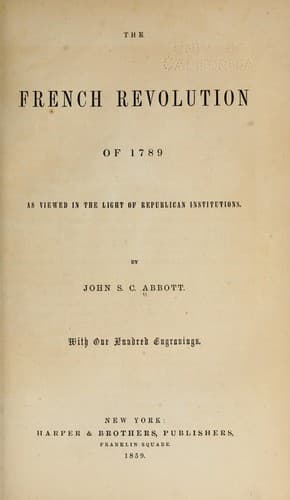
The French Revolution of 1789, as Viewed in the Light of Republican InstitutionsAbbott, John S. C. (John Stevens Cabot)
History
The French Revolution of 1789, as Viewed in the Light of Republican Institutions
Abbott, John S. C. (John Stevens Cabot)
France -- History -- Revolution, 1789-1799
[Footnote 61: There was at this time a nominal tax of two twentieths
upon all incomes, which the clergy and the nobility were to pay as
the rest. They contrived, however, in a great measure to evade this
tax. "The princes of the blood, for example," says Bouillé, in his
Memoirs, "who enjoyed among them from twenty-four to twenty-five
millions yearly ($5,000,000), paid for their two twentieths only
188,000 livres ($37,600) instead of 2,400,000 ($480,000). The Duke of
Orleans, who presided over the committee to which I belonged in the
Assembly of the Notables, said to me, one day, after a deliberation in
which we had considered and approved the establishment of provincial
administrations, 'Are you aware, sir, that this pleasantry will cost
me at least 300,000 livres ($60,000) a year?' 'How is that, my lord?'
I asked. 'At present,' he replied, 'I arrange with the intendants,
and pay pretty nearly what I like. The provincial administrations, on
the contrary, will make me pay what is strictly due.'"--_Bouillé's
Memoirs_, p. 41.]
[Footnote 62: "This body at first courageously sustained the blow which
had fallen upon them. But soon men accustomed to the pleasures of Paris
threw aside the mask of stoicism which they had assumed, and redeemed
themselves from exile by promising to adopt the views of the court,
provided that no new taxation was proposed."--_Desodoards_, vol. i., p.
68.]
[Footnote 63: The Marquis of Ferrières, a noble of high rank, was a
deputy of the nobles. He was a warm patron of the old opinions and
customs, and voted perseveringly with the majority of his order. In his
very interesting Memoirs he writes thus of the Duke of Orleans, upon
whom, of course, he could not look with a partial eye. "The duke was
himself without talents, and debased by a life of drunkenness; greedy
of money to a degree that would have been perfectly reprehensible in a
private man, but which was disgraceful and degrading in a prince. He
had every vice which can make crime odious, and none of the brilliant
qualities by which it can be in some degree illustrated in the eyes
of posterity. The dead feelings of the duke it was necessary to
animate in some way or other, that he might appear to have a wish for
something, and so they held out to him the supreme power, under the
title of lieutenant-general of the kingdom; all the public money at
his disposal, and in the event, which it was for him to hasten, the
crown for his children, and himself thus made the commencement of a new
dynasty."]
[Footnote 64: Carlyle, French Revolution, vol. i., p. 48.]
[Footnote 65: Biographie Moderne.
"Off Ushant some naval thunder is heard. In the course of which
did our young prince hide in the hold! Our poor young prince
gets his opera plaudits changed into mocking tehees, and can not
become Grand Admiral--the source to him of woes which one may call
endless."--_Carlyle, French Revolution_, vol. i., p. 43.]
Public-domain text, read in full here on John Shaqi.
Reviews
Reviews
No reviews yet
Be the first to share your thoughts on this work.
Elsewhere in the archive
Join the Discussion
Join the discussion
Sign in to leave a comment or review.
Sign InorCreate an account