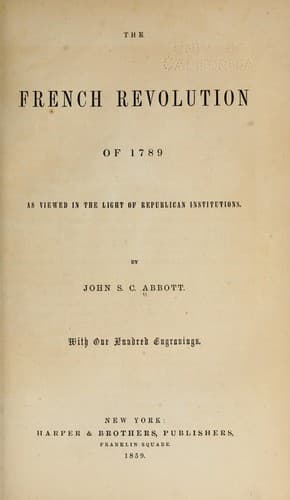
The French Revolution of 1789, as Viewed in the Light of Republican InstitutionsAbbott, John S. C. (John Stevens Cabot)
History
The French Revolution of 1789, as Viewed in the Light of Republican Institutions
Abbott, John S. C. (John Stevens Cabot)
France -- History -- Revolution, 1789-1799
Brienne, who now occupied the post of prime minister, wrote to M.
Necker entreating him to return to the post of Controller of the
Finance. Necker refused. He was not willing to take charge of the
finances with Brienne prime minister. Bankruptcy, with its national
disgrace and wide-spreading misery, was at hand. On the 16th of August
an edict was issued that all payments at the royal treasury should be
made three fifths in cash, and the remaining two fifths in promissory
notes bearing interest. As the treasury was without credit the notes
were comparatively valueless. This was virtual bankruptcy, in which the
state offered to pay sixty cents on the dollar. The announcement of
this edict rolled another surge of excitement and consternation over
the kingdom.
Count d'Artois called upon the queen and informed her of the terrible
agitation pervading the public mind. She sat down in silence and
wept. Brienne, pale, haggard, and trembling, frightened by the storm
now raging, having contrived to secure for himself property to the
amount of one hundred and fifty thousand dollars a year, gave in his
resignation, entered his carriage and drove off to Italy, leaving the
king to struggle alone against the Revolution.[77]
During these conflicts for power between the king and the nobles the
moan of twenty-five millions crushed beneath the chariot-wheels of
feudal aristocracy ascended, not unheeded, to the ear of Heaven. The
hour of retribution if not of recompense approached. For weary ages the
people had waited for its coming with hope ever deferred. Generation
after generation had come and gone, and still fathers and mothers, sons
and daughters were toiling in the furrows and in the shop, exclaiming,
"O God, how long!" The dawn after the apparently interminable night was
now at hand, but it was the dawn not of a bright but of a lurid day.
France at this time presented the spectacle of millions in misery, of
some thousands obtaining by the severest toil the bare necessaries of
life, and of a few hundred rioting in wealth and luxury.
FOOTNOTES:
[Footnote 58: Histoire Philosophique de la Revolution de France, par
Ant. Fantin Desodoards, t. i., p. 58.]
[Footnote 59: "Calonne has published a work on the French Revolution.
At the end of it he gives an outline of his plan. Nothing can be more
reasonable; and it remains an eternal indictment on the people of
consequence then in France, more particularly on that part of them
that composed the Assembly of Notables."--_Lectures on the French
Revolution, by Wm. Smyth_, vol. i., p. 122.]
[Footnote 60: Montgaillard, vol. i., p. 300.]
Public-domain text, read in full here on John Shaqi.
Reviews
Reviews
No reviews yet
Be the first to share your thoughts on this work.
Elsewhere in the archive
Join the Discussion
Join the discussion
Sign in to leave a comment or review.
Sign InorCreate an account