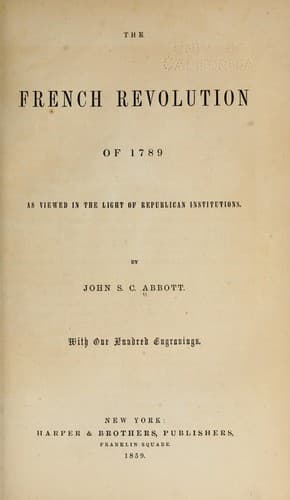
The French Revolution of 1789, as Viewed in the Light of Republican InstitutionsAbbott, John S. C. (John Stevens Cabot)
History
The French Revolution of 1789, as Viewed in the Light of Republican Institutions
Abbott, John S. C. (John Stevens Cabot)
France -- History -- Revolution, 1789-1799
Preparations were immediately made for the assembling of the
States-General, and the public announcement was given that it was
to be convened on the 27th of April. There had been no meeting of
the States-General for one hundred and seventy-five years, and
the question now rose, How shall the members be elected? who shall
be voters? of how many shall the body be composed? what proportion
shall be from the privileged and what from the unprivileged class?
The learned bodies and popular writers were invited to express
their views upon these points. Thousands of political pamphlets
immediately appeared, and every mind in the nation was roused.[79]
The all-important and most agitating question was, What proportion
shall the people occupy in this assembly? The unprivileged class
composed ninety-eight hundredths of the nation; the privileged class
two hundredths. And yet the privileged class demanded inexorably that
they should have two thirds of the representatives, and the people one
third. This would place the people in a hopeless minority, and leave
them entirely at the mercy of the privileged class.
To settle these agitating questions the Notables were again summoned
on the 6th of September, 1788. It was the same body which Calonne had
called together. Parliament had firmly declared in favor of allowing
the people a representation of but one third, giving the nobles a third
and the clergy a third. The king and Necker were fully assured that
such an arrangement could by no means satisfy the nation--that it would
be a mockery of the people which would only exasperate them. They hoped
that these Notables, carefully selected, though from the aristocracy,
would be willing to give ninety-eight of the people at least an equal
voice with two of the aristocracy.
The Abbé Sièyes had written a pamphlet which had produced a profound
impression throughout France. He thus asked, and answered, three
questions: "What is the Third Estate? The whole people. What has it
hitherto been in our form of government? Nothing. What does it want? To
become something."
But the Notables were now alarmed, and a warm discussion ensued between
the advocates of ancient traditions and of national justice. One alone
of the several committees into which the Notables were divided voted
in favor of allowing the people an equal representation with the
privileged classes. Monsieur, afterward Louis XVIII., was chairman of
that committee. When the king was informed of this vote he remarked,
"Let them add my vote: I give it willingly."[80] After a month's
session, the Notables, on the 12th of December, having accomplished
nothing, vanished, to appear no more forever.
Public-domain text, read in full here on John Shaqi.
Reviews
Reviews
No reviews yet
Be the first to share your thoughts on this work.
Elsewhere in the archive
Join the Discussion
Join the discussion
Sign in to leave a comment or review.
Sign InorCreate an account