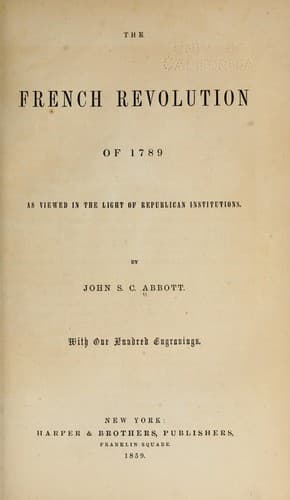
The French Revolution of 1789, as Viewed in the Light of Republican InstitutionsAbbott, John S. C. (John Stevens Cabot)
History
The French Revolution of 1789, as Viewed in the Light of Republican Institutions
Abbott, John S. C. (John Stevens Cabot)
France -- History -- Revolution, 1789-1799
There were a few of the nobles who were in favor of reform. In Provence
the nobility in their provincial parliament protested against the
royal edict, declaring that such innovations as were contemplated
tended to "impair the dignity of the nobility." One of their number,
Count Mirabeau, ventured to remonstrate against this arrogance, and
to advocate the rights of the people. He was a man of extraordinary
genius and courage, and before no mortal or assemblage of mortals could
his eye be compelled to quail. He persisted and stood at bay, the whole
Parliament, in a tumult of rage, assailing him. With amazing powers of
vituperative eloquence he hurled back their denunciations, and glared
upon them fiercely and unconquerably. He was a man of Herculean frame,
with a gigantic head, thickly covered with shaggy locks, and he would
have been an exceedingly handsome man had not his face been horribly
scarred with the small-pox. He was a man of iron nerve and soul, and
knew not what it was to fear any thing. Like most of the noblesse and
the higher clergy, he had lived a dissolute life. The parliamentary
assembly, in a storm of wrath, expelled him from their body. He left
the house, but in departing, in portentous menace, exclaimed:
"In all countries and in all times the aristocrats have implacably
pursued every friend of the people; and with tenfold implacability if
such were himself born of the aristocracy. It was thus that the last
of the Gracchi perished by the hands of the Patricians. But he, being
struck with the mortal stab, flung dust toward heaven and called on the
avenging deities; and from this dust there was born Marius--Marius, not
so illustrious for exterminating the Cimbri, as for overturning in Rome
the tyranny of the nobles."[85]
Mirabeau now threw himself into the arms of the Third Estate. That he
might more perfectly identify himself with them, he hired a shop, it is
said, in Marseilles, and put up his sign--_Mirabeau, Woolen-draper_.
By such influences he was elected deputy by the Third Estate both at
Aix and at Marseilles. With enthusiasm was he elected--with ringing of
bells, booming of cannon, and popular acclaim. He decided to accept
the election of Aix. His measureless audacity was soon called into
requisition to repel the haughtiness of the court.[86]
The nobles had obtained the decision that the people should not be
allowed the secret ballot, but should vote with an audible voice. They
cherished the hope that inferior people so dependent upon the higher
and wealthy classes, would not venture openly to vote in opposition
to the wishes of their superiors.[87] It was thought that the nobles
might thus be able to control the popular election. To render this more
certain, the people, in their primary assemblies, were only to choose
_electors_; and these electors were to choose the delegates. Thus then
was a double chance for intimidation and bribery.
Public-domain text, read in full here on John Shaqi.
Reviews
Reviews
No reviews yet
Be the first to share your thoughts on this work.
Elsewhere in the archive
Join the Discussion
Join the discussion
Sign in to leave a comment or review.
Sign InorCreate an account