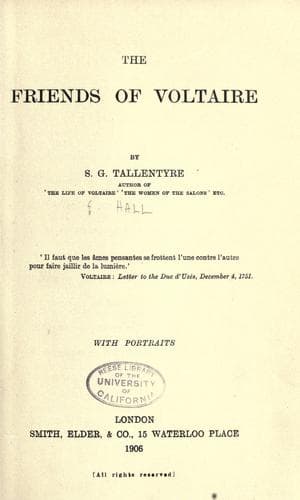
France -- Biography; Voltaire, 1694-1778 -- Friends and associates
One must picture him at this time as a tall, broad-shouldered, rather
handsome man, with that old boyish constraint in his manner, and that
strict high-mindedness which his own generation could not be expected to
find attractive. Add to these qualities that he was not in the least
carried away by dreams and visions, as were nearly all his friends, that
even then he saw the world as it was, and meant to do with it what he
could--that, though in lofty aim he may have been an idealist, he never
fell into the idealist’s fault of believing that, because there is
everything to do, he must do everything, or nothing. Just, reasonable,
practical--what a wholesome contrast to your visionary Rousseaus, ay,
and to your impulsive Voltaires! He was not a brilliant person, this; it
is said that he was slow in everything he undertook. Nor had he given
over the vigour of his youth and the strength of his understanding to
any one party. He was studying them all.
He was about three or four and twenty when he first began to go into the
intellectual society of Paris--when Montesquieu, d’Alembert, Galiani,
Helvétius, found the stiffness of manner more than redeemed by the
wealth of the mind. Presently he was introduced to Madame de Graffigny,
and complimented her by writing a long review of her ‘Letters from a
Peruvian,’ which, as giving his own views on education, on marriage, and
on the fashionable avoidance of parenthood, retains all its interest. It
is strange to hear a pre-Revolutionary Frenchman urging
love-marriages--‘Because we are sometimes deceived, it is concluded we
ought never to choose’--and strange also that, out of all the great
reformers with whom his name is associated, Turgot alone perceived the
fearful havoc which neglect of family duties makes in the well-being of
the State.
He was presented to Madame de Graffigny by her niece, Mademoiselle de
Ligniville. The bright and charming Minette naturally did not find it at
all difficult to draw Anne Robert of five-and-twenty from the
intellectual society of her aunt’s _salon_ to a game of battledore and
shuttlecock _à deux_. Morellet, watching the pair, professed himself
pained and astonished that their friendship did not end as nearly all
such friendships do and should.
Most of Turgot’s biographers have sought the reason why Mademoiselle de
Ligniville became Madame Helvétius and not Madame Turgot--and have not
found it. As for Turgot, he said nothing. It remains idle to speculate
whether he conceived for her a passion, which his _gaucherie_ and
shyness, perhaps, prevented her from returning; or whether he had
already devoted his life to his public duty, and thought that private
happiness would be deterrent and not spur to his work for the race. An
unhappy or an unrequited affection is one of the finest incentives to
labour and success one can have. It may be that Turgot had it. The only
certain facts are that Minette married Helvétius, and that Turgot
remained her life-long friend.
Public-domain text, read in full here on John Shaqi.
Reviews
Reviews
No reviews yet
Be the first to share your thoughts on this work.
Elsewhere in the archive
Join the Discussion
Join the discussion
Sign in to leave a comment or review.
Sign InorCreate an account