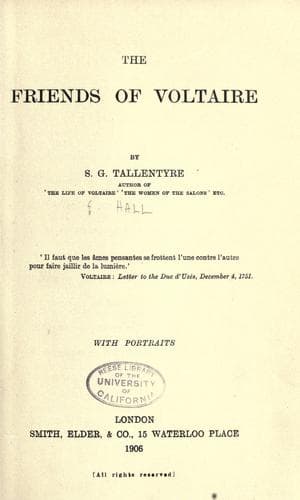
France -- Biography; Voltaire, 1694-1778 -- Friends and associates
On the other hand were the clergy--often ignorant, but generally cunning
enough to play on the deeper ignorance of their flock by threats of the
Hereafter, and to keep from them that knowledge which is the death-blow
of superstition.
Then there were the poor. Picture a peasantry whose homes were
windowless, one-roomed huts of peat or clay; who subsisted, in times of
plenty, on roots, chestnuts, and a little black bread; who had neither
schools nor hospitals, teachers nor doctors; who were the constant prey
of pestilence and famine; whose bodies were the possession of their
lords, and whose dim souls were the perquisites of the priests. Consider
that these people were not allowed to fence such miserable pieces of
land as they might possess, lest they should interfere with my lord’s
hunting; nor to manure their wretched crops, lest they should spoil the
flavour of his game; nor to weed them, lest they should disturb his
partridges. Consider that, if such land could have borne any fruit, a
special permission was required to allow its owners to build a shed to
store it in. Consider that their villages, in which they herded like
beasts, were separated from other villages by roads so vile that they
would have rendered commerce difficult, if legal trammels had not made
it impossible. Consider that these people had been scourged for
generations by hundreds of unjust and senseless laws, made by and for
the benefit of their oppressors, and that they were now the victims of
taxes whose very name has become an indictment, and whose description is
a justification of the French Revolution.
On the one flank they were whipped by the _taille_--the tax on the
income and property of the poor, which absorbed one-half of the net
products of their lands--and on the other by the _corvée_, which
compelled them to give yearly twelve or fifteen days’ unpaid labour on
the roads and the use of a horse and cart, if they had them. The
_milice_ demanded from each parish its quota of soldiers (the rich being
exempt as usual), and compelled the parishes to lodge passing
detachments of military and to lend cattle to draw the military
equipages. The _gabelle_, or tax on salt, forced each poor man to buy
seven pounds of salt per annum--whether, as in one province, it was a
halfpenny a pound, or, as in another, it was sixpence--and let the
noble, the priest, and the Government official go free. Toll-gates were
so numerous in the country that it is said fish brought from Harfleur to
Paris paid eleven times its value on the journey. Wine was taxed; corn
was taxed.
Public-domain text, read in full here on John Shaqi.
Reviews
Reviews
No reviews yet
Be the first to share your thoughts on this work.
Elsewhere in the archive
Join the Discussion
Join the discussion
Sign in to leave a comment or review.
Sign InorCreate an account