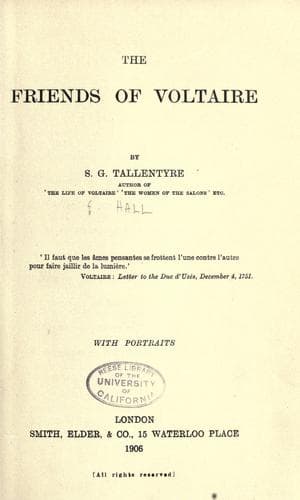
France -- Biography; Voltaire, 1694-1778 -- Friends and associates
But this was not all. If these taxes were cruelly unjust, they were
settled and regular. Irregular taxes could be levied at any moment at
the caprice of the despot at Versailles, who no more realised the
condition of his peasantry than an ordinary Briton realises the
condition of a tribe of Hottentots. One, called with an exquisite irony
the Tax of the Joyful Accession, had been raised when Louis the
Fifteenth reached the throne of France--to topple it down the abyss.
Another was the _vingtième_, or tax on the twentieth part of a franc,
which could be doubled or trebled at the pleasure of the Government.
Apart altogether from the taxes, the peasantry were subject to tithes
exacted by the Church, itself exempt from all taxation, to large fees
for christening and marrying, for getting out of the misery of this
world and avoiding worse misery in the next.
The clergy were on the spot to exact these dues, just as the middleman
was on the spot to exact the dues for the nobles. Some of these dues and
seigneurial rights are so shameful and disgusting that their very terms
are unrepeatable. Even that vile age permitted many of them to lapse and
become a dead letter; but the number, and the full measure of the
iniquity of those that were insisted on, has never been counted, and
will never be known until the Day of Judgment.
What effect would hundreds of years of such oppression have on the
character of the oppressed? Hopeless, filthy, degraded, superstitious
with the craven superstition which made them the easy prey of their
unscrupulous clergy and left them wholly sensual and stupid; as animals,
without the animals’ instinctive joy of life and fearlessness of the
morrow; with no ambitions for themselves or the children who turned to
curse them for having brought them into such a world; with no time to
dream or love, no time for the tenderness which makes life, life
indeed--they toiled for a few cruel years because they feared to die,
and died because they feared to live. Such were the people Turgot was
sent to redeem.
What wonder that many men gave up such a task in despair; that many even
good men found it easier to prophesy a Golden Age in luxurious Paris
than to fight hand to hand against the awful odds of such an awful
reality? Turgot was thirty-four when he went to Limoges, and forty-seven
when he left it. He spent there the most vigorous years of his life; if
he did not do there his most famous work, he did his noblest.
Public-domain text, read in full here on John Shaqi.
Reviews
Reviews
No reviews yet
Be the first to share your thoughts on this work.
Elsewhere in the archive
Join the Discussion
Join the discussion
Sign in to leave a comment or review.
Sign InorCreate an account