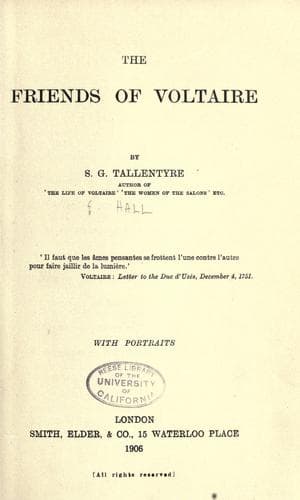
France -- Biography; Voltaire, 1694-1778 -- Friends and associates
In 1770 Duverney died, and Beaumarchais immediately quarrelled with his
heir, the Comte de la Blache, and plunged into a lawsuit over a sum of
fifteen thousand francs. Beaumarchais won the first move in the game.
But unluckily he had more than one iron in the fire just then. He fell
out fiercely with the Duc de Chaulnes over a Mademoiselle Mesnard, with
the result that the Duke was clapped into a fortress, and Beaumarchais
into the prison of For-l’Évêque. La Blache seized his opportunity,
brought his lawsuit before the Parliament of Paris, represented dumb and
imprisoned Beaumarchais as the greatest scoundrel unhanged, won his
cause, seized Beaumarchais’ furniture, and entirely ruined him.
Beaumarchais seldom lost his coolness and courage, and he did not lose
them now. While in For-l’Évêque he had been let out on leave three or
four times. He had taken these chances to try to win over to his side
Goezman, who was Judge-Reporter in the lawsuit with la Blache, and a
most unfavourable judge to Beaumarchais. By the simple and time-honoured
expedient of handsome bribes to the wife, Beaumarchais attempted to gain
the husband’s good will. Madame Goezman perfectly understands that,
should Beaumarchais lose his cause, she is to return his gifts of a
watch set in diamonds, and of money. The cause _is_ lost. She returns
the watch and money, save only a certain fifteen louis, to which, for
some absurd _raisonnement de femme_, she considers herself entitled, and
with which she will by no means part. Then Councillor Goezman comes
forward and accuses M. de Beaumarchais of seeking to corrupt his
integrity.
This ridiculous situation Beaumarchais seized as a golden opportunity to
restore his credit before the world, to dazzle it with his wit, to
entice it with his audacity, and to make it own him the man of matchless
cleverness he was. He appealed to public opinion, nominally to judge
between himself and Goezman, in reality to judge between him, Goezman,
la Blache, the Paris Parliament, and all his enemies and rivals
whomsoever, in four famous Memoirs, which divided Paris into two hostile
camps and fixed on him the delighted attention of Europe.
Except by name, and for a brilliant quotation here and there, few people
know the Goezman Memoirs now. But in fire, wit, and irony, they are
little, if at all, inferior to the comedies by which Beaumarchais lives.
In both are the same gay surprises of situation, banter and mockery,
parry and thrust--every page as light and elusive as thistledown borne
on a summer breeze. Their cleverness gained him the admiration not only
of a senile King, but of Voltaire as well. Old Ferney declared he had
never been so much amused in his life. ‘What a man!’ he wrote to
d’Alembert. ‘He has all the qualities;’ and again, ‘Don’t tell _me_ he
has poisoned his wife, he is much too lively and amusing for that.’
Public-domain text, read in full here on John Shaqi.
Reviews
Reviews
No reviews yet
Be the first to share your thoughts on this work.
Elsewhere in the archive
Join the Discussion
Join the discussion
Sign in to leave a comment or review.
Sign InorCreate an account