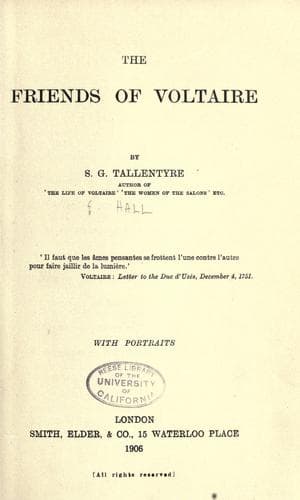
France -- Biography; Voltaire, 1694-1778 -- Friends and associates
Madame Dubarry had charades acted in her apartment, in which an
interview between Beaumarchais and Madame Goezman was represented on the
stage. The Memoirs were read aloud in the cafés. Of the Fourth, six
thousand copies were sold in a single day. Horace Walpole delighted in
them. Madame du Deffand gossiped of them. Bernardin de Saint-Pierre
prophesied for Beaumarchais the reputation of Molière.
What did it avail then, on February 26, 1774, when the case had lasted
some three years, to give judgment against him, sentence him to civic
degradation, prohibit him from the occupation of any public function,
and condemn the Memoirs to be burnt as scandalous, libellous,
defamatory? He was the victor not the less. ‘Le monde a beau parler, il
faut obéir,’ says Voltaire. The day after the sentence had been
pronounced, the Prince de Conti and the Duc de Chartres fêted the
criminal, and a delightful woman fell in love with him. Marie Antoinette
named her latest coiffure after a joke in the Memoirs. He was so wildly
applauded when he appeared in public that Sartine, the Lieutenant of
Police, advised him to appear no more. ‘It is not enough to be
condemned,’ says Sartine, ‘one should be a little modest still.’ The
Maupeou Parliament in attempting to destroy this wit had ruined itself.
Its ban was worse than useless. Beaumarchais was the fashion.
The King, to be sure, had to enjoin silence on this ‘terrible advocate,’
but he promised him a revision of his suit; and then employed him, in
March, 1774, as his secret agent in England to run to earth a person who
had threatened to publish a scandalous pamphlet on Madame Dubarry.
Beaumarchais succeeded in his mission. He always succeeded. But when he
returned to France, Louis the Fifteenth was dying, so for all his pains
his reward was, as he said, ‘swollen legs and an empty purse.’
Soon, however, news came of a libel against Marie Antoinette which was
being prepared in London. Off starts Beaumarchais again, pursues the
libeller (a shifty Jew) to Nüremberg, goes on to Vienna to procure from
Maria Theresa an extradition treaty against him, is himself thrown into
prison for a month, and then liberated with profusest apologies and the
offer of a thousand ducats. All his adventures were delightfully
romantic and picturesque; and with his eye for scenic effect, he took
care they should lose nothing in the telling.
Public-domain text, read in full here on John Shaqi.
Reviews
Reviews
No reviews yet
Be the first to share your thoughts on this work.
Elsewhere in the archive
Join the Discussion
Join the discussion
Sign in to leave a comment or review.
Sign InorCreate an account