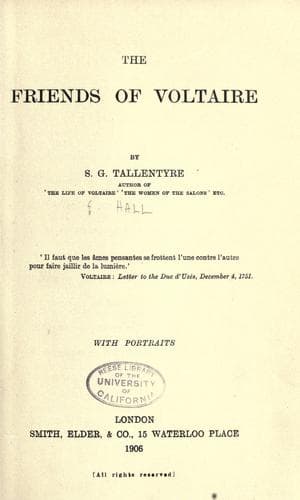
France -- Biography; Voltaire, 1694-1778 -- Friends and associates
The play was to begin at half-past five in the afternoon, but from early
in the morning the doors were besieged by crowds, in which _cordons
bleus_ elbowed Savoyards, and the classes and the masses began their
long struggle. In the press three persons were suffocated--‘one more
than for Scudéry,’ said caustic La Harpe. Great ladies sat all day in
the dressing rooms of the actresses to be sure of securing seats, and
duchesses were delighted to obtain a footstool in the gallery, a part of
the house to which, as a rule, ladies never went. The theatre was lit by
a new method. The famous Dazincourt played Figaro; and Molé, Almaviva.
The author himself was in a private box between two abbés who had
promised to administer ‘very spiritual succour’ in case of death. Then
the curtain rose.
‘The “Marriage of Figaro,” said Napoleon, ‘was the Revolution already in
action.’
As in the ‘Barber of Seville,’ the atmosphere and the clothes are
Spanish, the spirit and essence wholly French. The story of Figaro, the
servant who outwits his lord and wins Suzanne, whom his master has tried
to steal from him, forms a plot simple enough. Count Almaviva, the
master, is certainly one of the best representations of the great noble
of the old régime ever put on the stage. Continually worsted in argument
by his valet, and perpetually in the most ridiculous situations, he
never loses the dignity of good breeding--as Beaumarchais himself puts
it, ‘the corruption of his heart takes nothing from the _bon ton_ of his
manners.’ Figaro is, of course, democracy with its wits awake at last,
and stung to courage and action by centuries of wrongs. The Countess
(the Rosina of the ‘Barber’) and Suzanne are the most charming and
seductive reproductions of the eighteenth-century woman--‘spirituelles
et rieuses,’ coquettish, graceful and gay. The chief fault of the play
is the episode of Marceline, in which the playgoer wearily recognises
two, too familiar friends--the long-lost mother and the mislaid baby
with the usual convenient birth-mark on the right arm.
Public-domain text, read in full here on John Shaqi.
Reviews
Reviews
No reviews yet
Be the first to share your thoughts on this work.
Elsewhere in the archive
Join the Discussion
Join the discussion
Sign in to leave a comment or review.
Sign InorCreate an account