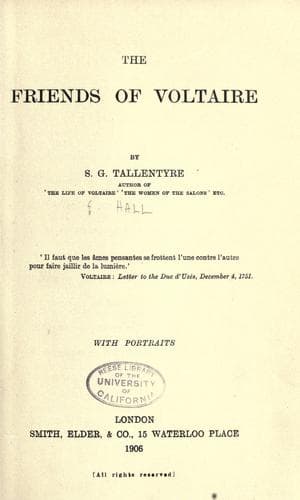
France -- Biography; Voltaire, 1694-1778 -- Friends and associates
After all, Louis was very weak, and public opinion very strong. The
First Gentleman of the Chamber permitted the thing to be rehearsed, more
or less publicly, in the theatre of the Hôtel des Menus Plaisirs. All
the world and his wife crowded thither. The Comte d’Artois was actually
on his way when, with an awakening of his feeble obstinacy, the King
sent a mandate forbidding the performance. Even Madame de Campan, kindly
old sycophant of the Court, confessed that there were angry whispers of
‘tyranny’ and ‘oppression,’ and murmurs of ‘an attack on liberty.’
Beaumarchais, stung to the quick, swore that it should be played, ay,
even if it was in the choir of Notre-Dame! The pressure on Louis was
great; the Court was in want of a new sensation, and to be made to laugh
at its own follies was a very new one indeed.
In three months, the Comte de Vaudreuil, the leader of Marie
Antoinette’s _société intime_ of the Little Trianon, obtained the royal
permission to have it acted in his house at Gennevilliers, by the
company from the Comédie, before the Comte d’Artois and the Queen’s
bosom friend, the Duchesse de Polignac. The Queen herself intended to
have been present, but was prevented by an indisposition. When the
permission was accorded, Beaumarchais was in England. He hurried home,
saw to the performance himself, and made his own conditions.
On September 26, 1783, three hundred persons, the very flower of Court
society, crowded into Vaudreuil’s theatre, and would have died of
suffocation if the resourceful Beaumarchais had not broken the panes of
the windows with his cane. It was said he had made a hit in two senses.
The aristocratic audience received his play with rapturous applause. He
adroitly followed up his success by presenting his piece to a tribunal
of censors who, for some unknown reason, ‘felt sure it would be a
failure,’ and expressed themselves satisfied with it after they had made
a few insignificant omissions. Finally, a reluctant permission was wrung
from the King, and on April 27, 1784, seven months after the performance
at Gennevilliers, ‘The Marriage of Figaro’ was first publicly performed
at the new Comédie Française, built on the site of the Hôtel de Condé,
and now known as the Odéon.
Public-domain text, read in full here on John Shaqi.
Reviews
Reviews
No reviews yet
Be the first to share your thoughts on this work.
Elsewhere in the archive
Join the Discussion
Join the discussion
Sign in to leave a comment or review.
Sign InorCreate an account