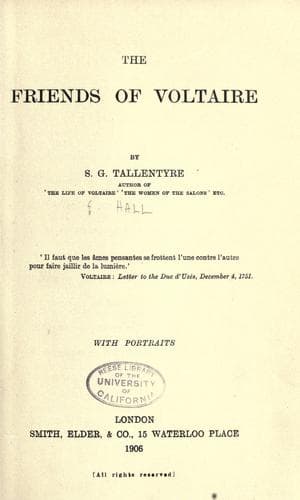
France -- Biography; Voltaire, 1694-1778 -- Friends and associates
Caron de Beaumarchais was not a very unusual type of character or even
of intellect; but in the use he made of his brains, of his qualities and
of his circumstances, he was a man in a million. His marvellous
enterprise and industry enabled him to build more than one successful
career on very ordinary foundations. His luck, that astonishing luck
which followed him from the cradle to the grave, seems to have prevented
such dangerous qualities as his conceit, his pugnaciousness, and his
love of intrigue and speculation, from bringing their usual fatal
results. Such gifts as a handsome face, a fine figure, a ‘parvenu
grandeur of manner’ and real kindness and generosity, he used to their
utmost advantage. For himself and his contemporaries he was a
brilliantly successful individuality.
For posterity, he is the man who, with a single thrust, pushed open that
door, which by long labour and bitter sacrifice Voltaire and the
Encyclopædists had unbarred, upon the great Revolution and the Day.
X
_CONDORCET: THE ARISTOCRAT_
Voltaire was the son of a lawyer, and Diderot the son of a cutler;
d’Alembert was a no-man’s child educated in a tradesman’s family; Grimm
and Galiani were foreigners in the country to which they gave their
talents. Of all Voltaire’s fellowship only Vauvenargues and Condorcet
came from the order their work was pledged not to benefit but to
destroy. Condorcet alone lived to experience the extreme consequences of
his principles, and paid for them by imprisonment and death. The
Aristocrat who lost his life through the People to whom he had devoted
it--this was Jean Antoine Nicolas de Caritat, Marquis de Condorcet.
Born in 1743, at Ribemont, a town in Picardy, Condorcet belonged to a
noble family highly connected both with the Church and the Army.
His father was a captain of cavalry and designed his son for the same
aristocratic post. But he died when the child was four; and a devout
mother vowed him to the Virgin and _au blanc_,
[Illustration: JEAN-ANTOINE-NICOLAS DE CARITAT, MARQUIS DE CONDORCET.
_From an Engraving by Lemort, after the Bust by St. Aubin._]
dressed him in white frocks like a little girl, so that the luckless
Caritat could neither run nor jump as nature bade him, and owed to his
mother’s piety a weakness in his limbs from which he never recovered.
His first schoolmasters were the Jesuits. What is one to make of the
fact that they had as virgin soil the intellects of at least four of
their mightiest and fiercest opponents--Voltaire, Diderot, Turgot, and
Condorcet?
At eleven, Caritat was under their supervision, with his home influence
pressing him to their way of thought, with an uncle a bishop, and
Cardinal de Bernis a relative. At thirteen, he was sent to Rheims, to be
more completely under their control. At fifteen, he came up to Paris,
and began at the College of Navarre to study mathematics and to think
for himself; and when once a mind has begun to do that, nothing can stop
it.
Public-domain text, read in full here on John Shaqi.
Reviews
Reviews
No reviews yet
Be the first to share your thoughts on this work.
Elsewhere in the archive
Join the Discussion
Join the discussion
Sign in to leave a comment or review.
Sign InorCreate an account