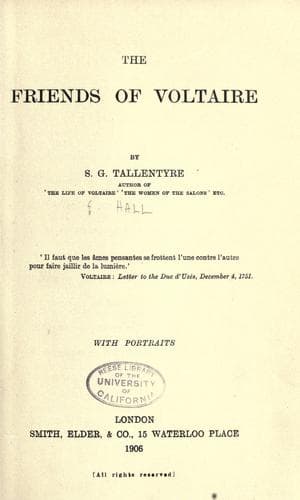
France -- Biography; Voltaire, 1694-1778 -- Friends and associates
His treatment of a particularly difficult theme brought him the
acquaintance of d’Alembert, who first saw in the boy, who was to be to
him as a son, a kindred genius, a future colleague at the Academy.
Caritat was only seventeen when he introduced himself to his other great
friend, Turgot, writing him a ‘Letter on Justice and Virtue’ which
already proclaimed this college student a thinker of a high order. An
‘Essay on the Integral Calculus,’ which he presented at the Academy of
Sciences when he was twenty-two, attracted to him the flattering notice
of the famous mathematician, Lagrange. There was in it not only the
ardour of youth and a buoyant fecundity of idea, but a profundity of
learning not at all youthful.
Caritat was now no longer a student, but still lodging in Paris. In
1769, when he was twenty-six, he entered the Academy of Sciences in
opposition to the wishes of all his relatives, who never pardoned him,
he said, for not becoming a captain of cavalry.
The man who ought, by the solemn unwritten laws of the family compact,
to have been a heavy dragoon, was soon acknowledged as one of the finest
original thinkers of his age, the friend of d’Alembert and of Voltaire,
and something yet greater than a thinker--greater than any great man’s
friend--a practical reformer and a generous lover of human-kind.
The character of Condorcet--he who with Turgot has been said to have
been ‘the highest intellectual and moral personality of his
century’--has in it much not only infinitely good, but also infinitely
attractive. Perfectly simple and modest, somewhat shy in the social
world which he himself defined as ‘dissipation without pleasure, vanity
without motive, and idleness without rest,’ among his intimates no one
could have been more gay, witty, and natural. Though his acquaintances
might find him cold, his friends knew well what a tender and generous
soul shone in the thoughtful eyes. If he listened to a tale of sorrow
coldly and critically almost, while others were commiserating the
unfortunate, Condorcet was remedying the misfortune. Though he never
could profess affection, he knew better than any man how to prove it;
and if all his principles were stern, all his deeds were gentle. So
quiet in his tastes that he had no use for riches, wholly without the
arrogance and the blindness which distinguished his class, he had its
every merit and not one of its faults; and he well deserved the title
Voltaire gave him--‘The man of the old chivalry and the old virtue.’
Public-domain text, read in full here on John Shaqi.
Reviews
Reviews
No reviews yet
Be the first to share your thoughts on this work.
Elsewhere in the archive
Join the Discussion
Join the discussion
Sign in to leave a comment or review.
Sign InorCreate an account