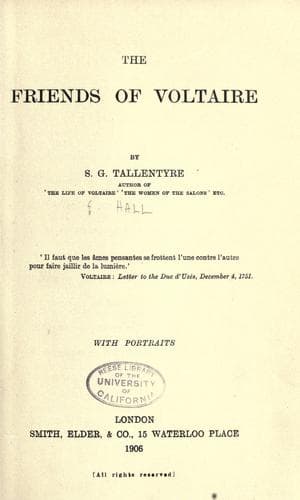
France -- Biography; Voltaire, 1694-1778 -- Friends and associates
There was never a time when Condorcet could be called either an orator
or a leader of men. Though he had written most of its official
addresses, he had appeared but little before the Legislative Assembly.
Nervousness caused him always to read any speeches he did make, and a
delicate voice robbed them of their effectiveness. His deeds and his
character earned him a hearing and applause; and sometimes his complete
self-devotion and the white heat of his enthusiasm discounted his manner
and touched his hearers with something of his own deathless passion. But
he was, as d’Alembert said, a volcano covered with snow, and that
audience of his, coarse in fibre, mad for excitement, overwrought,
uncontrolled, must needs see the mountain in flames, vomiting lava and
death.
To be a great orator one must have in a supreme degree the qualities
one’s hearers have in a lesser degree. The thoughtful reason and the
lofty ideals of Condorcet found little counterpart in the parliaments of
the Revolution. A Marat or a Danton for us! Or a Fouquier-Tinville even,
drunk with blood, with his wild hair flung back, and his words shaking
with passion; but not this noble, with the high courage of his caste,
his ‘stoical Roman face,’ his stern truthfulness, his unworldly
enthusiasms. Worse than all, Condorcet never was for a cause, but always
for a principle; and since he followed no party blindly, he was in turn
abused by all.
He proved in his own history that to be a great demagogue it is
essential to be without too fine a scrupulousness and the more delicate
virtues; that successfully to lead the vulgar the first requisite is not
to be too much of a gentleman.
Condorcet, although he had broken with monarchy as a possible form of
government for France, had still no personal feeling against the
monarch. Firmly convinced of his culpability, he was equally convinced
that the Convention was not legally competent to judge its King at all;
and proposed that he should be tried by a tribunal chosen by the
electors of the Departments of France. But to take the judging of its
sovereign from the Convention was to take the prey whose blood he has
tasted from the tiger. When the great moment came, Condorcet was at
Auteuil; he hastened to Paris, and arrived at the Assembly a few moments
before the King.
What a strange contrast was this Marquis--serene in strong purpose, with
his ‘just mind justly fixed,’ great in his compassion for his country
and not without compassion for his King--to that poor Bourbon, ‘who
means well had he any fixed meaning,’ and whom Condorcet himself
described in an admirable but rarely quoted description as standing
before his judges, ‘uneasy, rather than frightened; courageous, but
without dignity.’
Public-domain text, read in full here on John Shaqi.
Reviews
Reviews
No reviews yet
Be the first to share your thoughts on this work.
Elsewhere in the archive
Join the Discussion
Join the discussion
Sign in to leave a comment or review.
Sign InorCreate an account