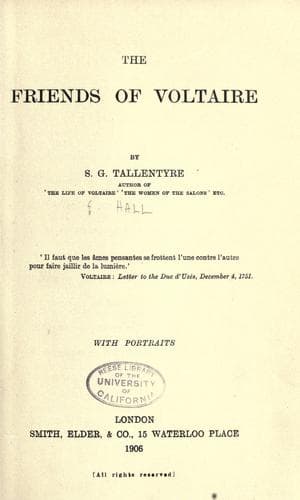
France -- Biography; Voltaire, 1694-1778 -- Friends and associates
In 1790, the profound happiness of his wedded life was crowned by the
birth of his only child, a daughter. Before that, the fierce whirlpool
of politics had drawn him into it, and he had addressed the electors of
the States-General and appeared publicly as the enemy of sacerdotalism
and aristocracy, with all his gospel based on two great principles--the
natural rights of man and the mutable nature of the constitutions which
govern him. He was made member of the municipality of Paris, and in
that, his first public function, flung the gauntlet before his caste and
broke for ever with an order of which the smug selfishness was admirably
typified by a Farmer-General who said to him, ‘Why alter things? _We_
are very comfortable.’
The fall of the Bastille, the insurrection of October, the journey of
the Royal Family to Paris, he had watched with the calm of one who knows
that such things must needs be, who realises the necessity of painful
means to a glorious end. To the monarchy he was not at first opposed. If
the King were but a man! But when in June, 1791, came the ignominious
flight to Varennes, Condorcet rose in a fierce, still wrath and
proclaimed the necessity for a Republic. ‘The King has freed himself
from us, we are freed from him,’ said he. ‘This flight enfranchises us
from all our obligations.’
Nearly all the Marquis’s friends broke with him, and he stood alone.
Before his ripened views on royalty were fully known, it had been
proposed that he should be the tutor of the Dauphin, and to Sophie that
she should be the _gouvernante_. Husband and wife were in different
places when the proposals were made; but, though they had never spoken
with each other on the subject, they declined the offers almost in the
same words. If Condorcet’s friends misunderstood him and parted at the
parting of the ways, his wife never did.
In 1791, he was elected member for Paris in the Legislative Assembly and
became in quick succession its Secretary and its President. As its
President, he presented to it his Educational Scheme, startlingly modern
in its demands that education should be free and unsectarian.
By the order of the Assembly, in 1792, there was burnt in Paris an
immense number of the brevets and patents of nobility--among them the
patent of Jean Antoine Nicolas de Caritat, Marquis de Condorcet--at the
very moment when at the bar of the tribune Condorcet himself demanded
that the same measure should be adopted all over France. Not one
dissentient voice was raised against the scheme; who, indeed, should
dissent from it when a marquis proposed it? A few months later he was
elected Member of the National Convention for the Department of Aisne,
and the extremist of the Legislative Assembly found himself all too
moderate for the Convention.
Then came the trial of the King.
Public-domain text, read in full here on John Shaqi.
Reviews
Reviews
No reviews yet
Be the first to share your thoughts on this work.
Elsewhere in the archive
Join the Discussion
Join the discussion
Sign in to leave a comment or review.
Sign InorCreate an account