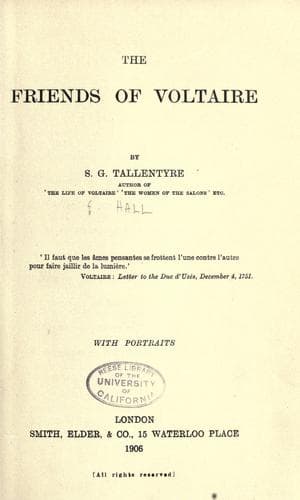
France -- Biography; Voltaire, 1694-1778 -- Friends and associates
It was an oasis in the desert of the feverish existence to which he had
condemned himself. In mighty speculation, in splendid visions of the
future of the race, in passionate argument on the immortality of the
soul and the being and nature of God, he forgot his personal sorrows.
The mind dominated and the heart was still. What nights the three must
have spent together--Voltaire with his octogenarian’s intellect as keen
and bright as a boy’s, the young Marquis, sharp-set to learn, and
d’Alembert with his ‘just mind and inexhaustible imagination’--when they
could get rid of that babbling inconsequence, Voltaire’s niece, Madame
Denis, and sit hour after hour discussing, planning, dreaming! The quiet
d’Alembert went, as quiet people often do, far beyond his impulsive and
outspoken companions in speculative daring. Though there is not an
anti-Christian line in any of his published writings except his
correspondence, yet the scepticism of this gentle mathematician far
exceeded that of him who is accounted the Prince of Unbelievers, and
where his host was a hotly convinced Deist, d’Alembert only thought the
probabilities in favour of Theism, and was far more Voltairian than
Voltaire. It was the old Pontiff of the Church of Anti-Christ who
stopped a conversation at his table wherein d’Alembert had spoken of the
very existence of God as a moot point, by sending the servants out of
the room, and then turning to his guests with--‘And now, gentlemen,
continue your attack upon God. But as I do not want to be murdered or
robbed to-night by my servants, they had better not hear you.’
The visit lasted in all two months. D’Alembert abandoned the Italian
journey, offered King Frederick his change, and returned to Paris.
In 1772 he was made Perpetual Secretary of the French Academy. He, whose
needs, said Grimm, were always the measure of his ambitions, had scaled
heights, not beyond his deserts, but beyond his wishes. He was also a
member of the scientific Academies of Prussia, Russia, Portugal, Naples,
Turin, Norway, Padua, and of the literary academies of Sweden and
Bologna. But if ‘the end of all ambition is to be happy at home,’
d’Alembert had failed. When the Perpetual Secretaryship was still a new
and dazzling possession, the Perpetual Secretary found at home the woman
to whom he was captive soul and body, in the throes of another passion.
False to de Mora, as she had been false to him, she was then writing to
de Guibert those love-letters which have given her a place beside Sappho
and Eloïsa and have added a classic to literature. It was d’Alembert’s
part to listen to self-reproaches whose justice he might well guess, to
look into the depths of a tenderness in which he had no share. Once he
gave her his portrait with these lines beneath it:
Et dites quelquefois en voyant cette image
De tous ceux que j’aimai, qui m’aima comme lui?
She herself said that of all the feelings she had inspired, his alone
had not brought her wretchedness.
Public-domain text, read in full here on John Shaqi.
Reviews
Reviews
No reviews yet
Be the first to share your thoughts on this work.
Join the Discussion
Join the discussion
Sign in to leave a comment or review.
Sign InorCreate an account